SUMMITS
SUMMIT Nº 34: Galdhøppigen (Norway)
NORWAY

Galdhøppigen

12/07/2026
ALTITUDE
2.469 m

ANDREU LÓPEZ

DIFFICULTY LEVEL
MEDIUM
CHRONICLE
I had just returned from my trip to Serbia and was already eager for another adventure when a sudden flash of inspiration pointed me towards Norway. Whenever I get a strong feeling like this, I usually trust it. So, during one particularly productive evening, I booked my flight, rented an electric automatic car (it would be my first experience driving both an electric vehicle and an automatic transmission), and reserved my first night in Oslo, followed by three nights in the village of Lom, located about four hours from the capital. It would become my base camp while exploring the Scandinavian Alps.
July 10th arrived sooner than expected. Barely a month and a half had passed since my Balkan adventure with my nephews. My Norwegian Airlines flight was scheduled to depart from Terminal 2 of Barcelona–El Prat Airport at 3:30 p.m., and I found myself rushing through the final travel preparations.
Unlike my two previous journeys in 2026—to Ireland and Serbia—when I travelled with nothing more than carry-on luggage, this time I decided to bring winter mountaineering equipment. My backpack included a helmet, an ice axe, crampons, warm clothing, and other essential gear in case I encountered snow on the mountain.
Over the previous few days, I had been closely monitoring the weather forecast. Although temperatures had gradually increased, the summit was still expected to experience lows of –5°C and highs of only 5°C, conditions that left me wondering what I would find once I reached the top.
I left my apartment in Collbató at 12:30 p.m. and arrived half an hour later at the AENA car park, next to Terminal 2, where I quickly ate the lunch I had prepared before setting off. Despite it being the middle of July, the terminal was surprisingly quiet, and I completed all the airport formalities in less than ten minutes.
I still had more than an hour and a half before boarding, so I took advantage of the downtime to get some work done. Lately, my job had been particularly demanding, and I sometimes found it difficult to disconnect from my computer for several consecutive days. Even so, I never saw working during my holidays as a burden. On the contrary, I consider myself incredibly fortunate to have a profession that I genuinely love.
The flight to Oslo lasted three and a half hours, time that I divided between catching up on some much-needed rest after an intense working week and reading one of the two books I had brought with me: Journey to the Center of the Earth, by the visionary French writer Jules Verne, one of the great masters of world literature and a true pioneer of adventure fiction.
Oslo Airport is not particularly large, and after collecting my luggage I headed towards the Hertz rental desks. The company appeared to be well established throughout Scandinavia, and the excellent reviews I had read convinced me to rent my car from them.
Once the paperwork was completed and the contract signed, I walked over to collect the vehicle. The moment I sat behind the wheel, I realised I had a problem… or rather, two.
First, I had no idea how to adjust the driver’s seat—my feet were several inches away from the pedals. Second, and far more importantly, I had never driven an automatic car before and had absolutely no idea how to operate one.
Better safe than sorry, so I headed back to the Hertz office and asked one of the employees if she would mind giving me a quick tutorial on how the car worked.
The lesson was short but remarkably effective. As it turned out, adjusting the seat simply required a little more video game experience, since the controls worked exactly like a joystick. As for the automatic transmission, everything was operated through a small selector mounted behind the steering wheel, allowing the different driving modes to be engaged with ease.
The car is truly a marvel, equipped with numerous intelligent systems that make driving both safer and more comfortable. Renting it for six days, with full insurance included, cost me €325, which is remarkably inexpensive by Norwegian standards. If you plan to rent a car in Norway, I would definitely recommend choosing an electric vehicle. Opting for a petrol or diesel car can easily double or even triple the rental cost.
Oslo is about 45 minutes away from the airport. Since Gardermoen Airport is located some distance from the city, I take the drive at a relaxed pace. Everything feels different compared to my own KIA Sportage, so I prefer to familiarize myself with the vehicle gradually. At the same time, I drive with extreme caution, as Norway is famous for its strict speed limits. Exceeding the limit by as little as 20 km/h can result in an €800 fine, as well as a court appearance.
Oslo is Norway’s capital and largest city, with a population of around 700,000. It is also the country’s political, economic, and cultural centre.
I check into the Scandic St. Olavs Plass, a hotel offering excellent value for money. As soon as I arrive, I settle into what I jokingly call the Spanish table, because tonight Spain faces Belgium in the FIFA World Cup quarter-finals.
The match is evenly contested throughout, although the injury to Belgian goalkeeper Thibaut Courtois proves decisive. Spain eventually wins 2–1, securing a place in the semi-finals.
Even though it is already 11:30 p.m., night never seems to fully arrive in Norway. It is time to call it a day. I head up to my room, read a few more pages, put on my sleep mask to block out the lingering daylight still filtering through the window… and finally drift off to sleep.
Check-out is at 12:00 p.m., so I decide to leave my luggage in the room and spend the morning strolling through Oslo’s main shopping streets. I also take the opportunity to visit the place where the Nobel Peace Prize is awarded—the only Nobel Prize presented in Oslo, while all the others are awarded in Stockholm, Sweden.
The city is buzzing with World Cup fever. Everywhere I look, groups of young Norwegians are preparing for the evening’s match against England, a fixture that promises to be an exciting encounter.
The walk is fairly short, but it feels good to stretch my legs for a couple of hours. I also manage to pick up a few souvenirs before returning to the hotel at noon. I collect my car, which has spent the night “sleeping” in an underground paid parking garage, and set off towards my next destination.
The location I enter into Waze is Kvila Hytteutleie, about four and a half hours from Oslo. The Norwegian capital lies in the south of the country, while Trondheim, Norway’s third-largest city, is located much farther north. Kvila sits roughly halfway between the two.
Today’s only objective is to reach Kvila, so I take the drive slowly and simply enjoy the journey. Beyond Lillehammer, much of the route follows roads where the speed limit is 80 km/h, making for a relaxed drive.
The scenery is simply breathtaking. A powerful river runs alongside the road for miles, while an endless forest stretches as far as the eye can see. I genuinely feel at home in this country. Norway is, without question, one of my favourite destinations in the world.
One aspect to keep in mind when travelling with an electric car is battery charging. The recommendation is not to let the battery drop below 20%. Since I’m still a complete beginner with electric vehicles, I ask a few fellow drivers for help while they are charging their own cars. The process isn’t entirely straightforward, as you first need to download a specific mobile app before you can start charging.
The cost pleasantly surprises me—less than €15 for a full charge. I also enjoy the idea of travelling using clean energy, so much so that I begin seriously considering buying an electric car the next time I change vehicles. While the battery charges, I take the opportunity to have lunch.
At around 7:30 p.m., I arrive in Kvila, which will be my home for the next three days. I’ve booked a small riverside cabin that turns out to be exactly what I need. It has two beds, a sofa, a table that will be perfect for getting some work done, and a fully equipped kitchen with a refrigerator.
More than enough. The three nights cost me €260 in total—an absolute bargain considering Norwegian prices, where even a simple pizza for dinner can cost around €40. So, my friends, if you’re planning a trip to Norway, make sure you keep a close eye on your travel budget.
By 9:00 p.m., I’ve already had dinner, and the match between Norway and England doesn’t kick off until 11:00 p.m., so I spend most of those two hours preparing my backpack and clothes for tomorrow’s adventure while also studying the route I plan to follow. As with every Top Summit, I’ll be taking the classic route—the easiest option and the one that avoids crossing the glacier, where hiring a professional mountain guide is strongly recommended.
The match between Norway and England fails to live up to expectations. Both teams play cautiously, producing a rather uninspiring game. That’s often the nature of knockout football: no one wants to make the mistake that sends them home, so both sides are reluctant to take risks.
I would have loved to see Norway progress, but fortune smiles on the Three Lions, who book their place in the semi-finals against Messi’s Argentina.
It’s time to call it a night. In just a few hours, Mr. Sun will be knocking on my window once again.
Getting a deep night’s sleep in Norway isn’t easy. There’s always a hint of daylight, and by around 5:00 a.m., the sun is already beginning to rise above the horizon. But today there are no excuses—it’s summit day, and my body knows it.
The route begins at Spiterstulen Mountain Lodge, located at approximately 1,100 metres above sea level, which I reach after driving along a 20-kilometre mountain track. A quick tip for anyone planning this ascent: access to the private road leading to the lodge must be paid for through a mobile app, and parking in the gravel area beside the trailhead also requires payment. Failing to do so can result in hefty fines. When it comes to following the rules, Norwegians don’t believe in half measures.
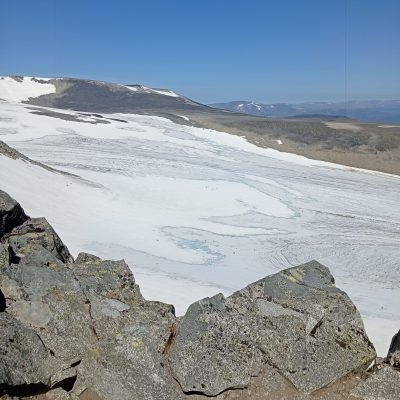
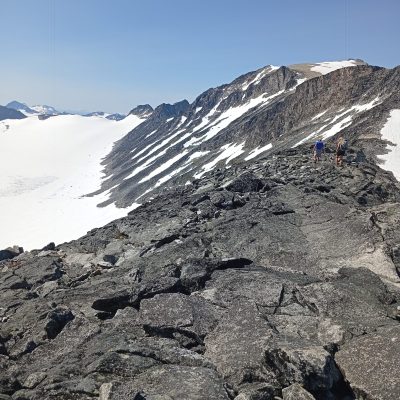
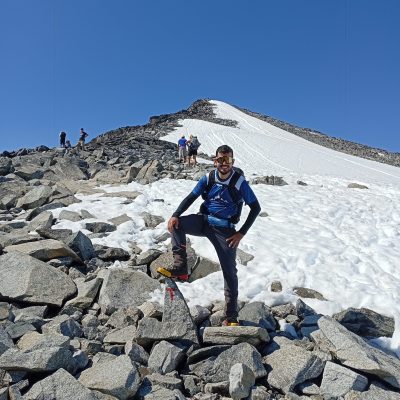
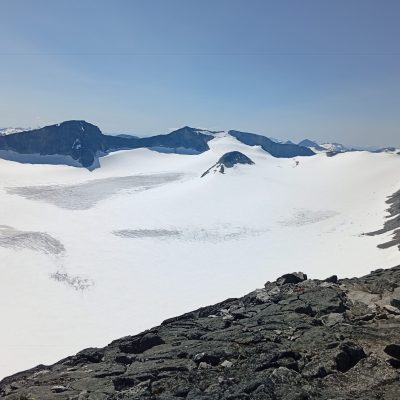
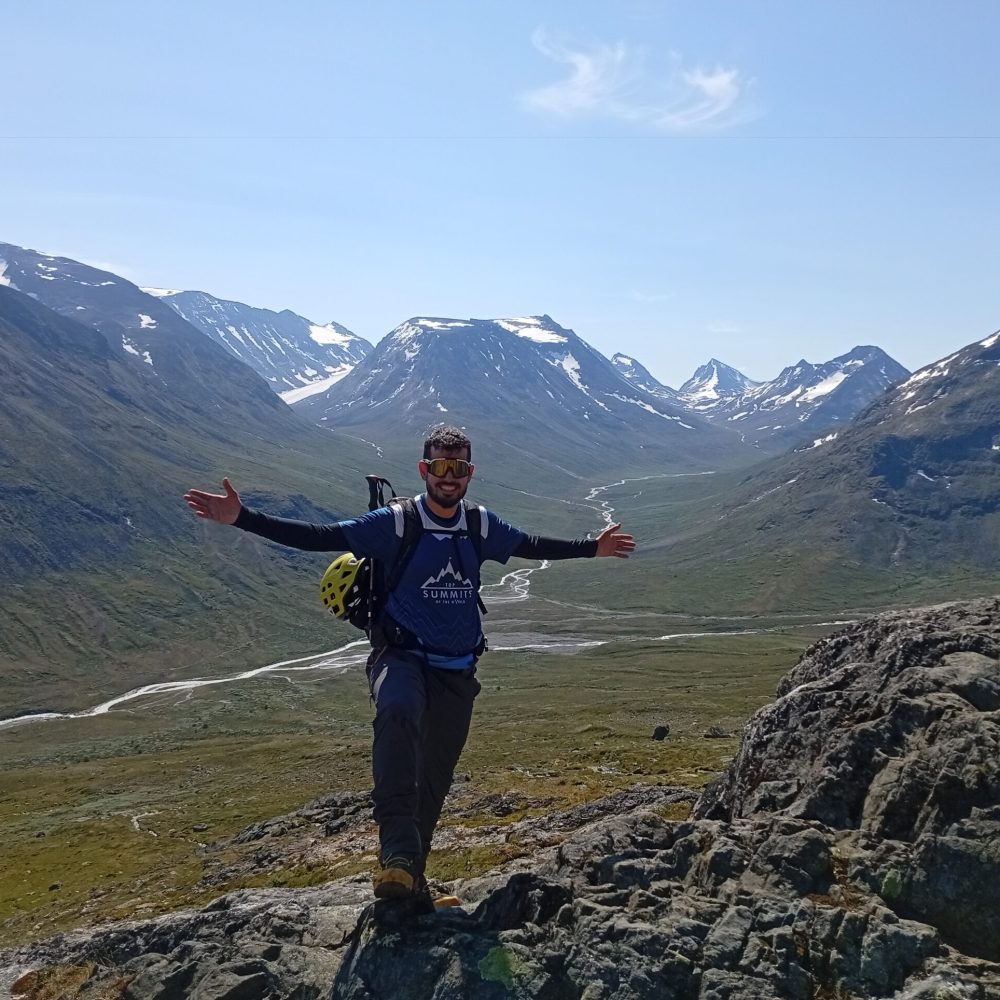
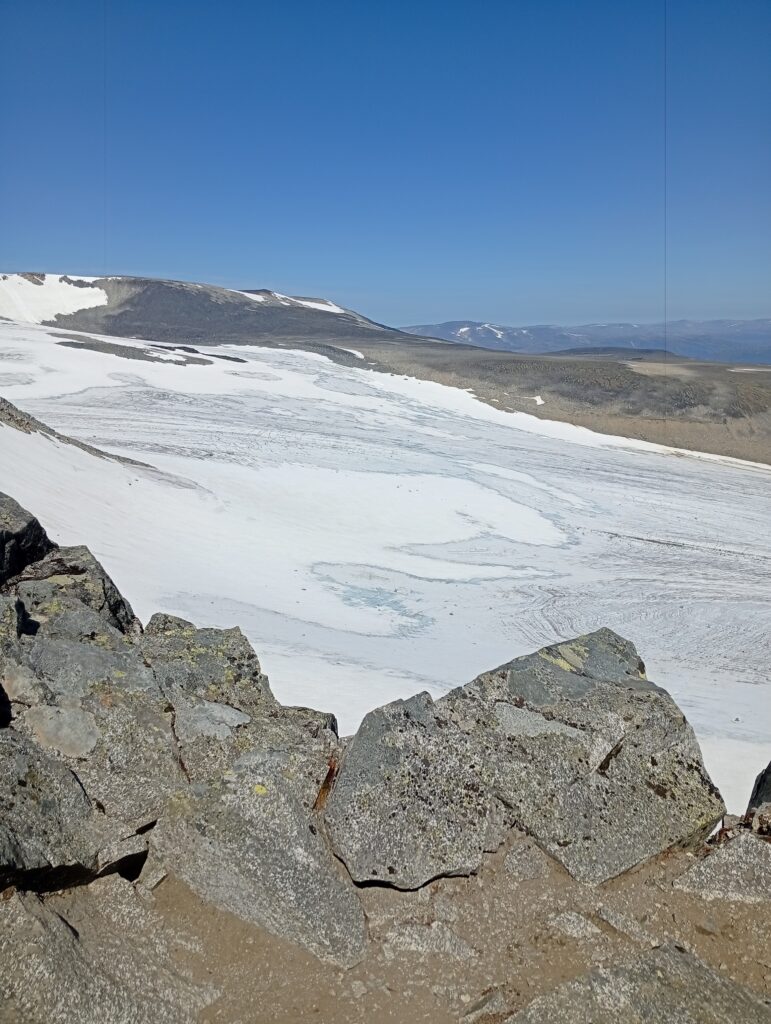
The Spiterstulen route is the least technical way to reach the summit. The alternative route crosses the glacier and requires hiring a certified mountain guide. The standard route is a straightforward out-and-back hike of approximately 12 kilometres (6 kilometres each way), involving nearly 1,400 metres of elevation gain. The ascent follows an endless boulder field that demands constant concentration, as there are very few sections without rocks underfoot. In several places, the trail crosses small snowfields, but the path is clearly marked and, under today’s conditions, no technical equipment is required.
As I make my way uphill, I confirm something I had already suspected: Norwegians are incredibly fit, and hiking is clearly one of their greatest passions. I share the mountain with countless local hikers, enjoying a fantastic day in exceptional weather. The sky is cloudless, temperatures are surprisingly pleasant, and at times it almost feels as if I’m hiking somewhere in the Mediterranean rather than deep inside the Scandinavian Alps.
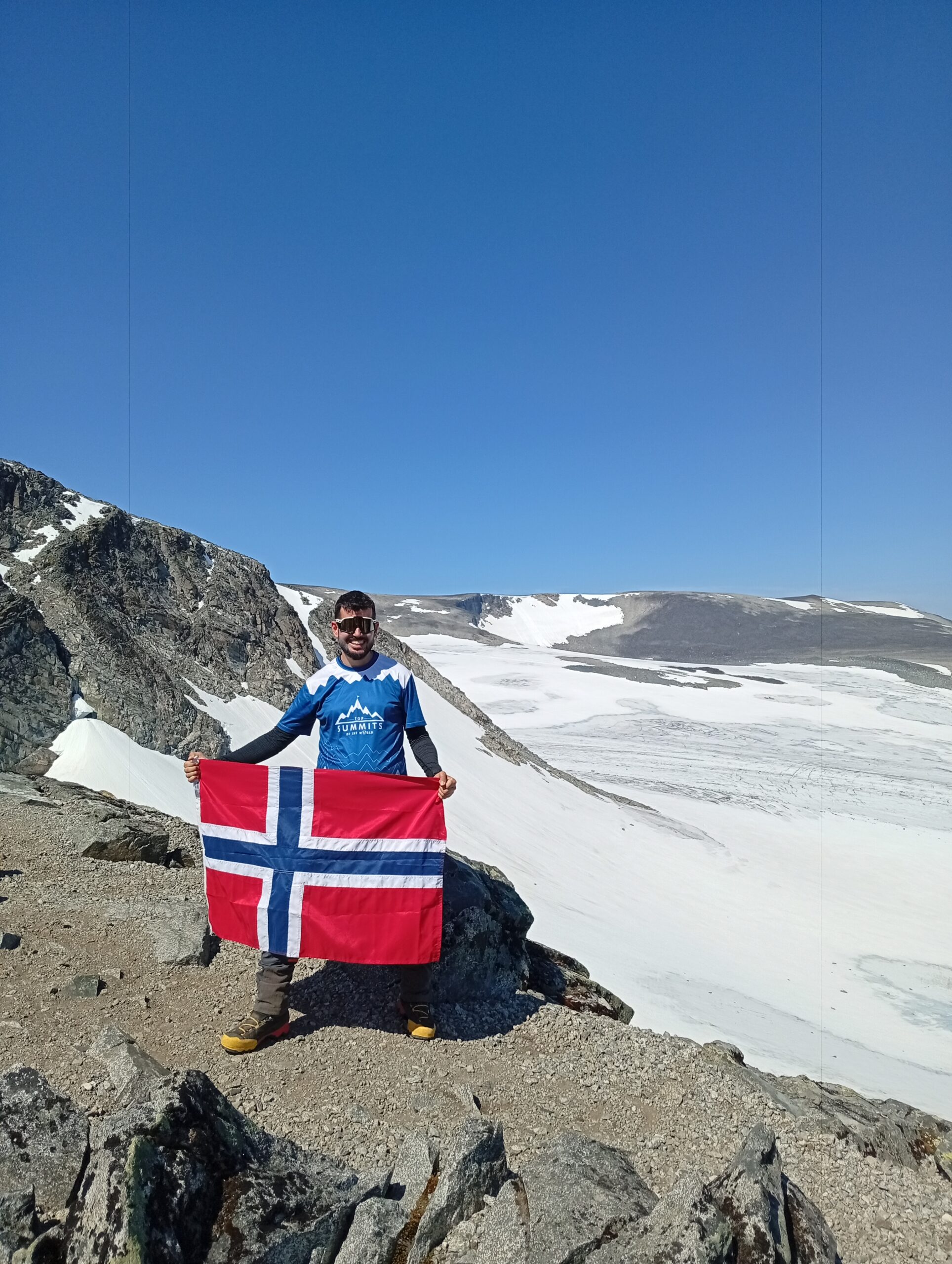
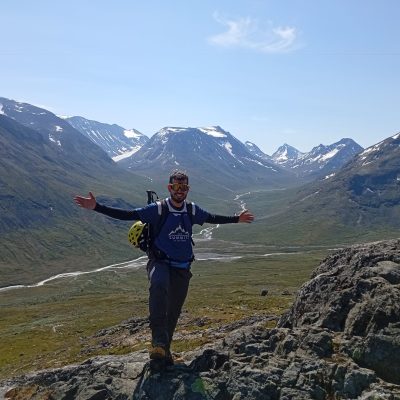
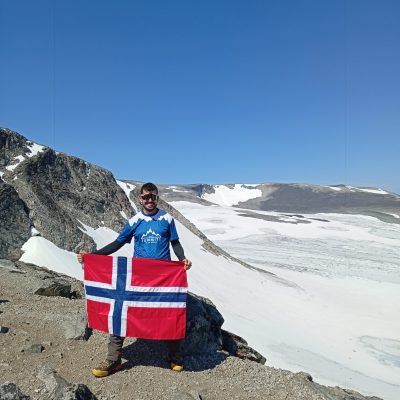
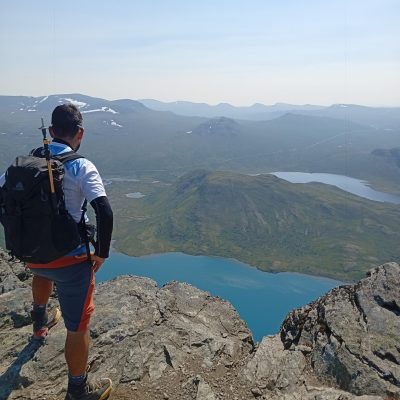
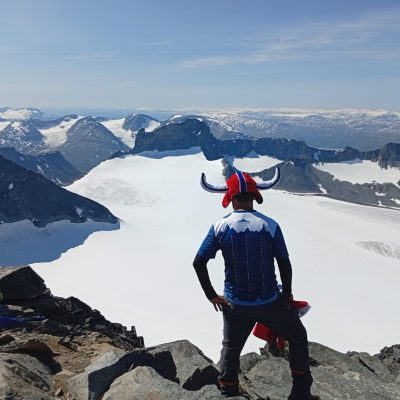
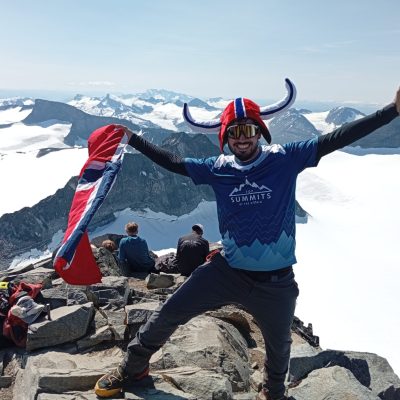
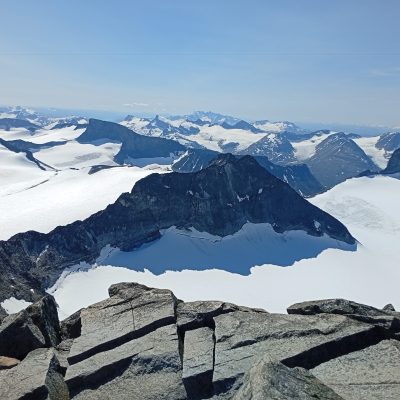
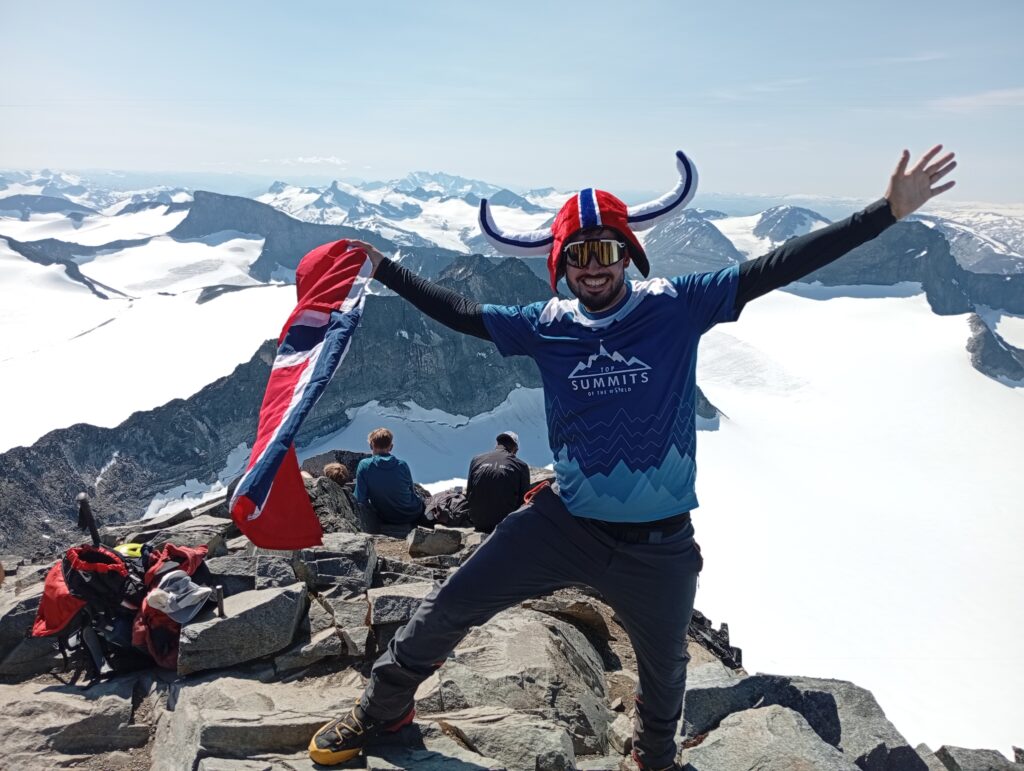
The route to the 2,469-metre summit is perfectly marked with red trail markers that guide hikers all the way to the top. Once I reach the summit, every step of the climb feels worthwhile. The views are simply breathtaking, and Galdhøpiggen rewards the effort with an extraordinary 360-degree panorama over the Scandinavian Alps.
Personally, reaching this summit fills me with immense satisfaction. It is Top Summit number 34, and it also marks another return to Norway—one of my favourite countries in the world thanks to its spectacular landscapes, its remarkably well-organised society, the strength of its communities and, above all, the warmth and kindness of its people.
I arrive back in Kvila at around 7:30 p.m. and opt for the easiest dinner option: returning to the little pizzeria next to my accommodation. The pizzas aren’t particularly good, they certainly aren’t beautiful, and they’re definitely not cheap, but there isn’t another restaurant within ten kilometres. Today I’m fully in mountain hut mode, so convenience wins.
After dinner, I head back to my cabin. I spend some time reading and finally finish Journey to the Center of the Earth by Jules Verne. I also tidy up my room and backpack, upload the day’s latest photos to Instagram, and then call it a night. It has been a long and rewarding day, and my body is more than ready for some well-earned rest.
The sunlight wakes me at around 5:30 a.m. Today isn’t a hiking day, so I allow myself the luxury of staying in bed a little longer.
There are no major tourist adventures to share today. The realities of being a freelancer and running my own business mean that an intense day of work lies ahead—professional adventures that, this time, I’d rather keep to myself.
Even so, I take the day at a relaxed pace, treating myself to several breaks during which I simply sit and watch the river flowing alongside my cabin. Around 8:00 p.m., I drive to Lom to stretch my legs and enjoy something for dinner that isn’t another €40 pizza.
I’m back in Kvila now. The Greek salad turned out to be an excellent choice. The evening walk was delightful, and I even managed to enjoy a few quiet moments of reading while the last rays of sunlight gently warmed my face.
I head to bed. Tomorrow brings another hike, and I’d like to get a little more—and hopefully better—sleep than I have over the past few days.
The next morning, I leave Kvila, but not before saying goodbye to the owners, who have been incredibly kind throughout my stay. They even allowed me to charge my car overnight, a gesture I truly appreciate.
The journey continues through fjords, lakes, rivers and breathtaking landscapes, this time along the famous Besseggen Ridge—a hike that I can confidently rank among the ten best routes I have ever completed.
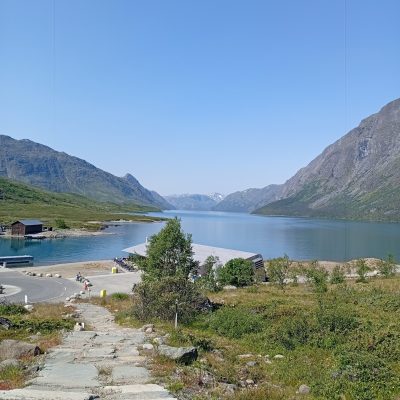
The trail begins at Gjendesheim, about 1,000 metres above sea level, after parking the car in a paid parking area and catching a shuttle bus (of course… also paid 😜). The distance between the car park and the trailhead is only about 1.5 kilometres, so anyone who prefers can easily skip the bus and walk instead.
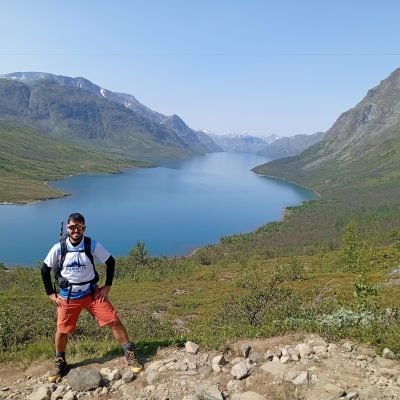
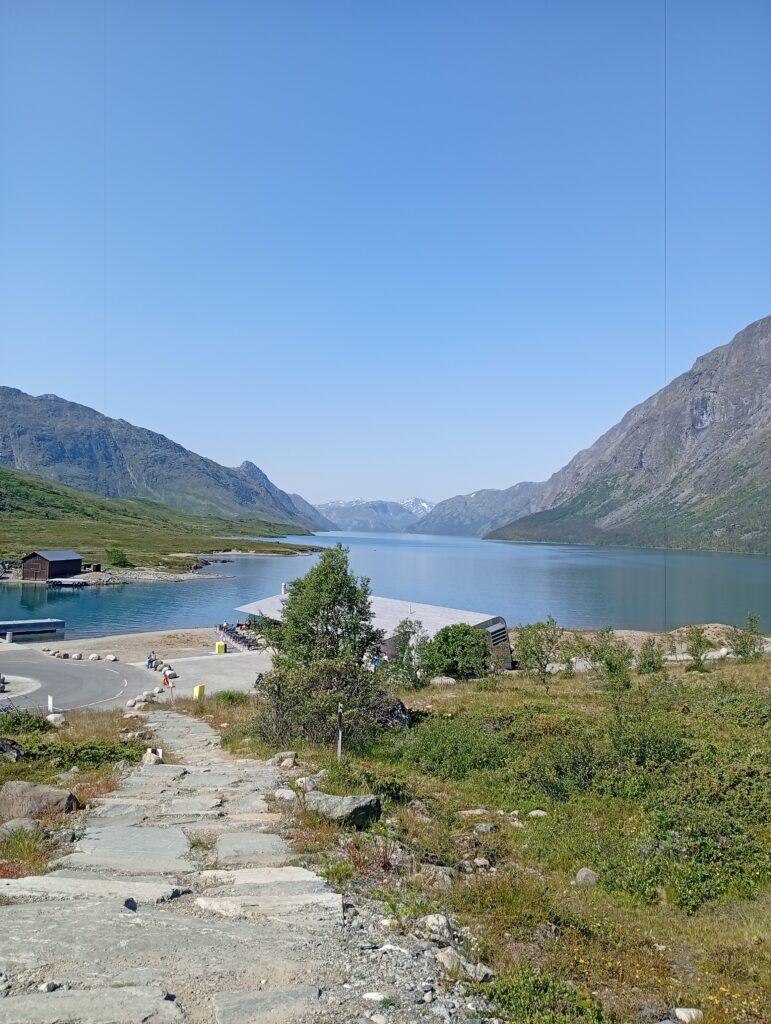
We are now in the eastern part of Jotunheimen National Park, beside the immense Lake Gjende, which has been a constant companion throughout my travels in this remarkable region of Norway.
In recent years, I’ve learned to plan only the essentials and let the locals guide the rest of my journey. More often than not, their advice turns out to be the best. This hike is a perfect example, recommended by the many friendly Norwegians I have met during this trip.
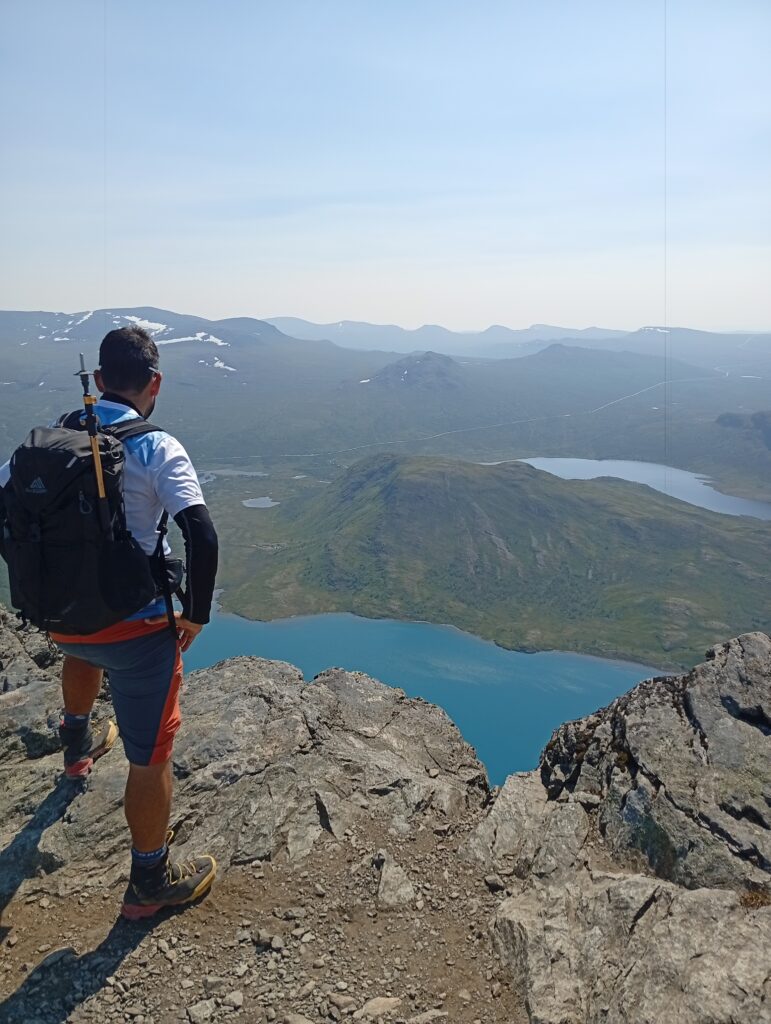
As the trail climbs higher, the scenery becomes even more spectacular. At around 1,600 metres, the landscape is so breathtaking that words struggle to do it justice. Endless lakes, rivers merging together, vast green valleys and mountains stretching all the way to the horizon… Once again, I find myself in a country where nature is almost a religion. You can sense the Norwegians’ deep connection with their environment at every step, making the experience all the more meaningful.
After reaching the 1,600-metre mark, the trail continues for another three to four kilometres across relatively flat terrain, offering extraordinary views, especially to the left, over a truly magnificent landscape.
The hike covers approximately 15 kilometres, with around 1,000 metres of elevation gain. Between kilometres 8 and 10, the route becomes more technical and exposed, featuring a few short scrambling and down-climbing sections. Even so, it never feels particularly dangerous, as the ridge is wide and provides solid handholds throughout.
The trail finishes in Memurubu, also at roughly 1,000 metres above sea level, where a ferry takes hikers back across the lake to the starting point in a relaxing 20-minute boat ride.
With this hike, my TSOW adventures in Norway come to an end.
To make the drive back to Oslo a little easier, I decide to spend the night in Lillehammer, located roughly halfway between the mountains and the airport. The town is best known for hosting the 1994 Winter Olympic Games, although beyond its Olympic legacy it doesn’t offer many major tourist attractions. Still, it makes for the perfect overnight stop before heading home.
Today is also football day—and not just any football match.
The first FIFA World Cup semi-final is about to kick off, with Spain taking on France.
Unfortunately, luck isn’t on my side. The internet connection and mobile coverage are surprisingly poor for Norway, and I end up watching the match through constant interruptions and frozen screens. A real shame, because games of this calibre don’t come around very often, especially with some of the world’s finest players on the pitch.
Today fortune doesn’t smile on me, but it certainly smiles on Spain, who comfortably overcome the mighty France to book their place in the World Cup Final.
Au revoir, les Bleus.
I wake up the following morning. Once again, there are no tourist adventures to share. I spend the entire morning working from the campsite where I’m staying until 3:00 p.m. After that, it’s time for lunch, washing the car, charging the battery one final time, and beginning the drive back towards the airport.
As the journey draws to a close, I can’t help feeling deeply grateful for everything I’ve experienced over these past few days. Although I travelled alone, paradoxically I never truly felt alone. Whenever I needed help, advice, or simply someone to share a moment with, someone always seemed to appear along the way.
Thank you, Norway, for giving me another unforgettable chapter of TSOW—this one with a true Viking spirit.
GALLERY