SUMMITS
SUMMIT No. 32: Carrauntohill (IRELAND)

IRELAND

Carrauntohill

04/04/2026
ALTITUDE
1,038 m

ANDREU LÓPEZ

DIFFICULTY LEVEL
MEDIUM
REPORT
I’ve been working nonstop from Monday to Sunday throughout January, February, and March, with practically no free time. I often think outside the box, so one day, late at night, I decided to send a message to the universe: I’ll book some flights to Ireland, where I’ll spend five days during Holy Week this year. I’ve had a lot of obligations and tight schedules for many days now—mainly due to work—so I decided to book only the first night of the trip and, from there, just go with the flow and figure out the rest of the itinerary as I go.
Ireland, also known as the Republic of Ireland, is a member country of the European Union, so you can leave your passport at home and forget about having to exchange euros for British pounds. However, you won’t be able to avoid driving on the left or needing a power adapter. Ireland’s population exceeds 5 million, and its capital is Dublin, located in the eastern part of the country, with a population of about 600,000 (1,800,000 in the metropolitan area).
The modern Irish state achieved effective independence from the United Kingdom in 1922, following the War of Independence, which ended with the signing of the Anglo-Irish Treaty, while Ulster—later Northern Ireland—remained part of the United Kingdom. This exacerbated the “Northern Ireland Conflict,” which continues to this day, despite peace negotiations between pro-British unionist forces and the population, which seeks independence from the United Kingdom and integration with the Republic of Ireland.
Let’s put the past and history behind us and move on to the present—specifically, Friday, April 3, when my flight from Reus to Dublin departs at 9:50 a.m. Flying out of Reus isn’t a common choice, but if we want to avoid crowds and get a competitive price, it’s a more than valid option worth considering (especially for destinations like the ones we’re heading to).
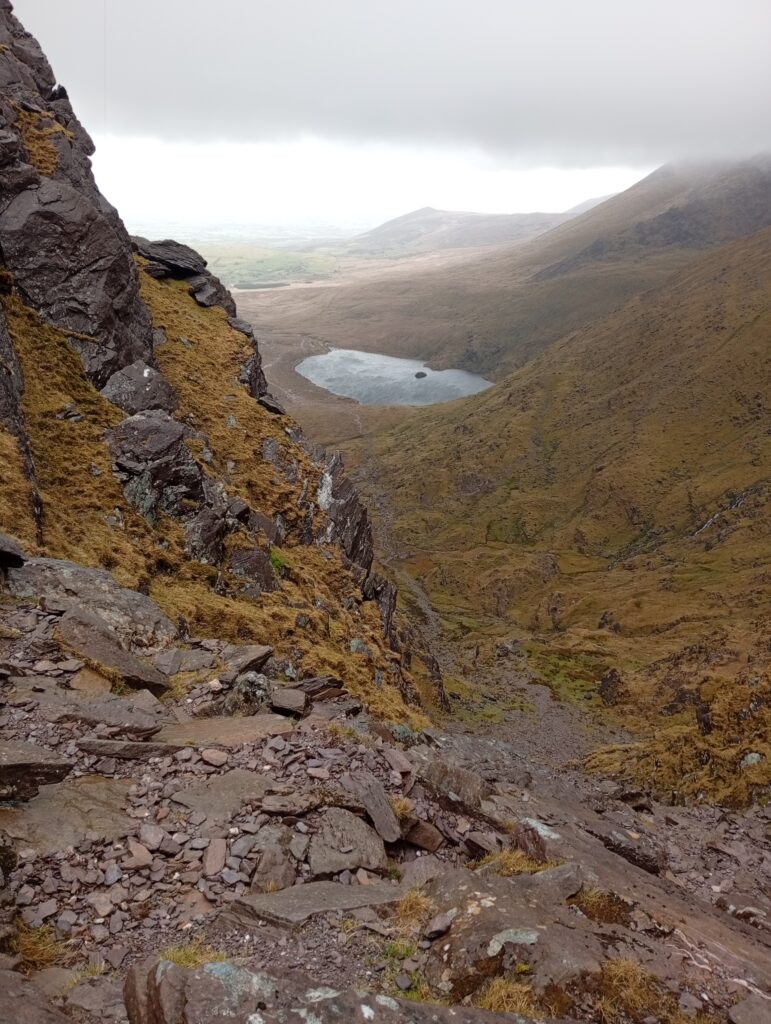
The trip is short—about 2 hours—and as soon as I arrive, I head to the Europcar offices. The first hour of driving is quite stressful for me, since driving on the left is compounded by the traffic, which is very common in the capital, Dublin, during certain rush hours of the day. The drive from Dublin to Killarney, in the eastern part of the country, takes me a good 4.5 hours. I’m staying at the Líos Na Manach ECO B&B, which is surrounded by beautiful green meadows and set apart from the town center, making it a very peaceful option.
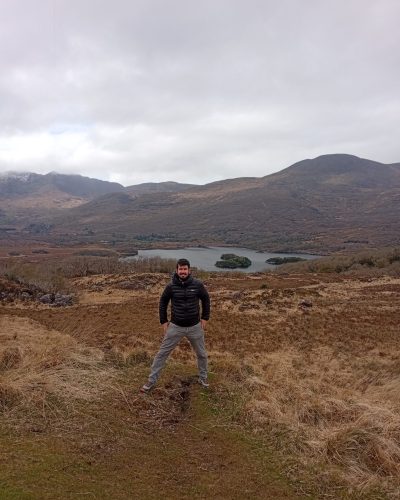
I don’t stay at the lodging for too long, since I’ve spent almost the entire day traveling by car and sitting down, and I’m eager to get some exercise on my own. So I head to the Killarney Lakes, where, making the most of the last few hours of daylight, I’ll complete a lovely 2-hour loop hike.
Tomorrow is the day I’ll climb to the country’s highest peak, Carrauntoohil, at 1,038 meters. My years of mountaineering experience have taught me never to underestimate any kind of ascent, no matter how modest its elevation. I had initially planned to complete a route that would take me up Ireland’s three highest mountains, but this option involved a certain degree of technical difficulty. Combined with the fact that I’m traveling alone on this expedition and that the weather forecast calls for rain and winds of around 100 km per hour, means the “triple crown” option is out of the question. Climbing Carrauntoohil and its 1,038 meters via the classic route will already be quite an undertaking.
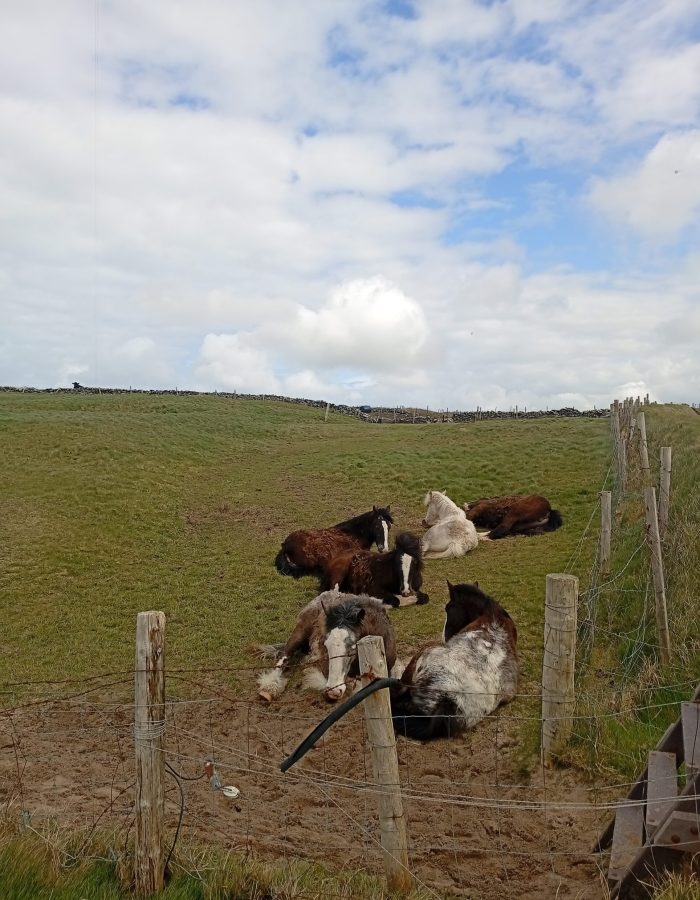
I would have had to get up really early, but, as always, I don’t—and I’m certainly no role model in this regard. The storm is expected to peak around 1:00 p.m., and I assume it will catch me up in the high elevations. The distance between Killarney and Cronin’s Yard, the trailhead, is a 30-minute drive. Cronin’s Yard is located in Beaufort, County Kerry, and is a predominantly rural area.
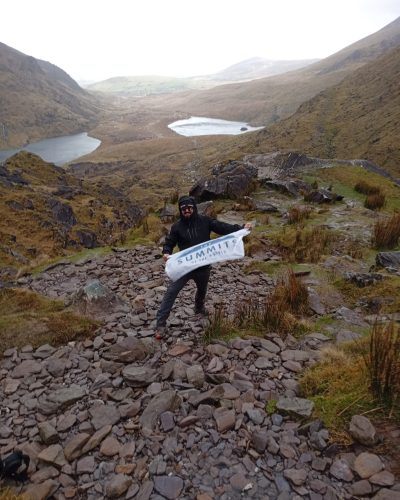
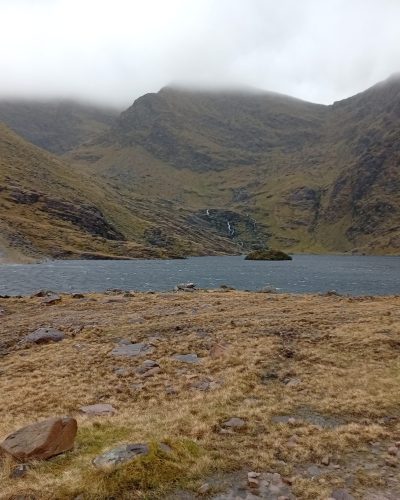
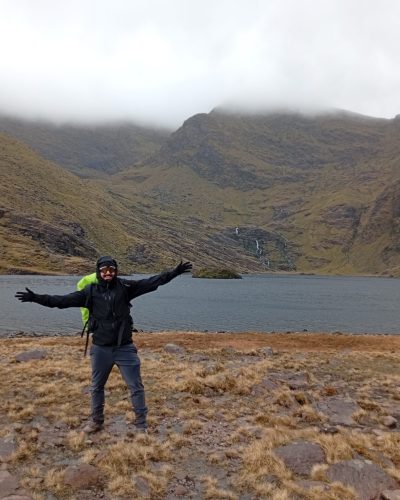
I start the hike around 10:30 a.m. from Cronin’s Yard, 200 meters above sea level, and I have about 6 kilometers to go to the summit and about 900 meters of elevation gain before retracing my steps along the same path. The first 4 kilometers are mostly flat and present no difficulty beyond the discomfort of the strong wind and rain (which are relentless and intense). Today’s forecast calls for the rain and wind to peak around 1:00 p.m., so I take the opportunity to walk quickly on this more forgiving terrain and make sure to spend the worst few hours away from the open, most exposed area at the summit.
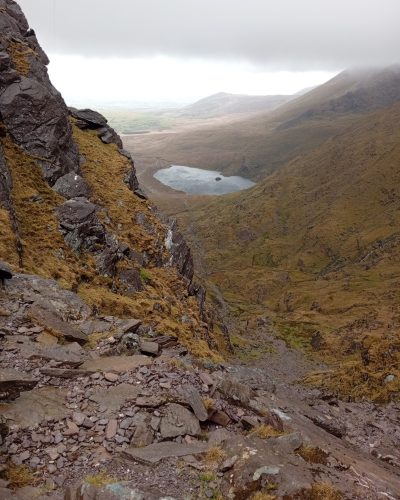
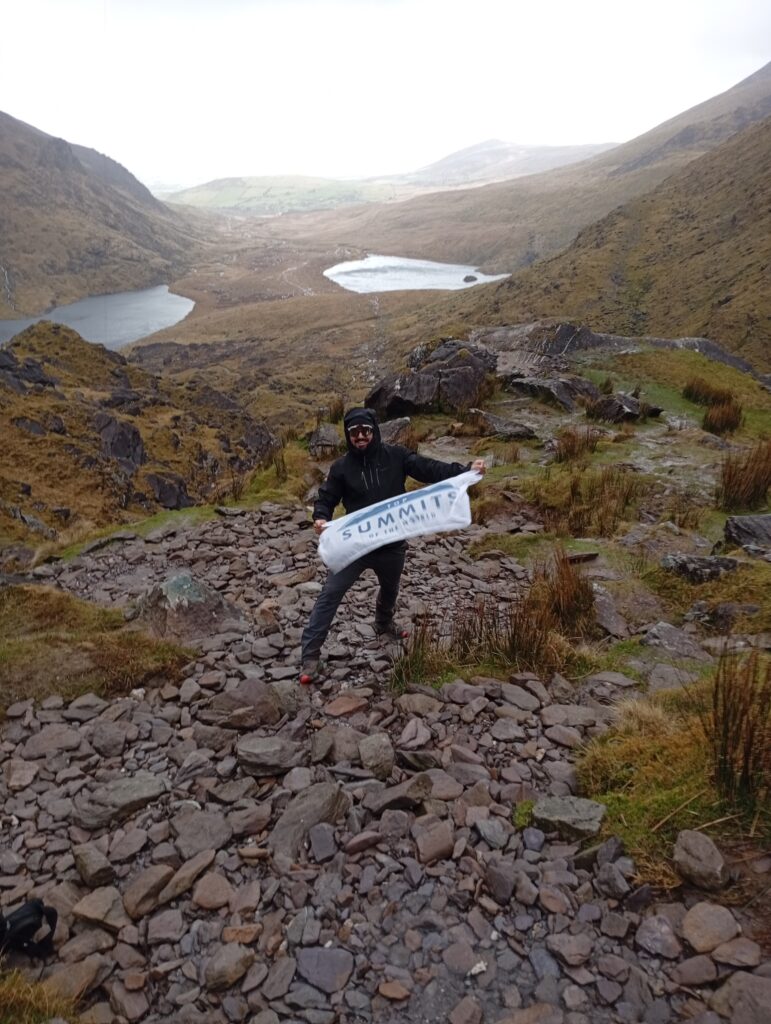
I pass two lakes—one on my left, the other on my right—and arrive at the famous “Devil’s Ladder.” It’s a vertical slope—though not at all technical—and, as far as I’m concerned, it’s a godsend, since it’s a hidden corridor that shields me quite well from the wind and rain. I come across hikers heading down. Some haven’t reached the summit—since they decided not to continue at the pass due to the strong wind—and others have made it to the top, though at times they had to crawl on all fours because of the strong wind.
I made rapid progress and reached the pass, which is located at an altitude of about 700 meters. And from there to the summit, it was a whirlwind of wind—I easily encountered gusts exceeding 100 kilometers per hour—though I remained calm and felt in complete control of the situation at all times.
I reach the summit at 12:30 and from there I head back down as fast as I can, though I’m careful. I finish the hike with about 3 or 4 kilos of water soaked into my clothes, though I’m beaming with happiness from the experience and adventure I’ve had today. And that’s it—I figure that once my clothes are dry, I’ll have earned a stop at an Irish pub.
After a day like yesterday, spent out in the open and completely exposed to the elements, it’s time to enjoy the comfort of having a roof over your head, as well as a mode of transportation that lets you explore the country in a relaxed and peaceful way. So I booked a guided bus tour called “The Ring of Kerry,” which takes us to various points of interest in the county, departing from Killarney.
I’ve been trying for 5 minutes to understand what the bus driver—who’s also the tour guide—is saying, but I’ve given up. I can’t understand even 10% of what the man is saying, with his thick accent and at a speed that even Usain Bolt himself could attest to. The day-long tour is great (language barriers aside), and we’re enjoying the ever-present, radiant sunshine that didn’t make an appearance at all yesterday on Carrauntoohill. During the tour, we’re taken to The Kerry Bog Village, a village where 19th-century houses remain intact, and where you can see the various trades that once took place within them. In addition, our attention is drawn to two Irish Wolfhounds—the tallest dog breed in the world, with males exceeding 80 centimeters in height and 50 kilograms in weight.
Another must-see are the “Kells Sheepdogs,” which are sheepdogs with a remarkable ability to guide flocks of sheep. Although for a Catalan like me, who is used to watching the annual competitions in the region (Castellar de N’Hug), this activity isn’t surprising (unlike for the rest of the group).
Throughout our tour, we follow the coastline the entire time and get to enjoy some spectacular scenery. The driver makes several stops so we can capture the moment, and around 5:00 p.m., we complete the loop through County Kerry.
I switched from the bus to a rental car and drove to the Dingle Peninsula—a completely impromptu tourist destination suggested by someone at the hotel where I stayed last night. On this trip, I’ve been taking things as they come, and honestly, it’s been a great choice because it hasn’t tied me down as much and has given me room to maneuver and the freedom to decide where to go at any given moment. The drive from Killarney to Dingle takes an hour and is simply spectacular, as it runs along the coast the entire way.
I’m staying in a renovated house with rooms overlooking the sea (the concept of a hotel does exist on the islands, though it’s not the norm). I’m greeted by two enormous yet gentle Irish Wolfhounds. The house has a charming bar-library area, where I enjoy a local beer before calling it a day.
Ireland is like plucking the petals off a daisy. On the day we visited Carrauntoohill, we had strong gusts of wind and rain; the next day, Sunday, we enjoyed constant sunshine; and on Monday, the sea “breeze” was back again. But we made the best of it, so we set out to explore the Dingle Peninsula—by far the most beautiful, spectacular, and wild place I’ve seen during my time in Ireland (this time in 2026, and also the first time, quite a few years ago, in 2005).
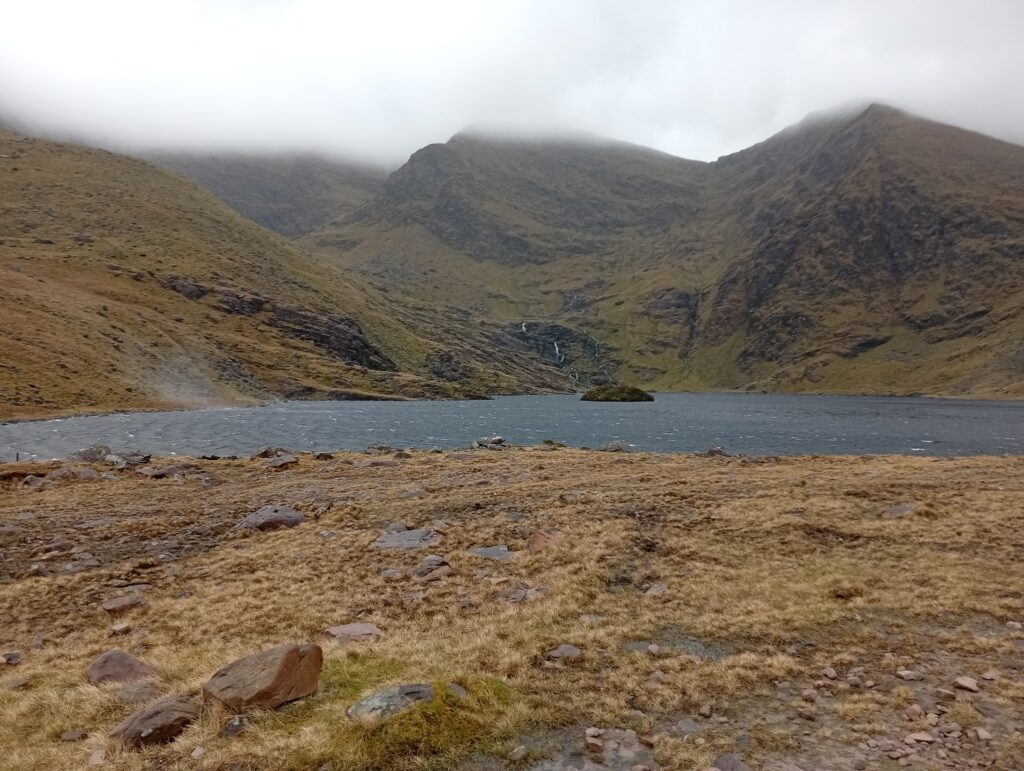
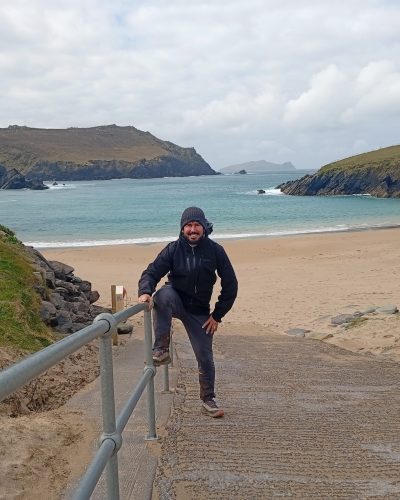
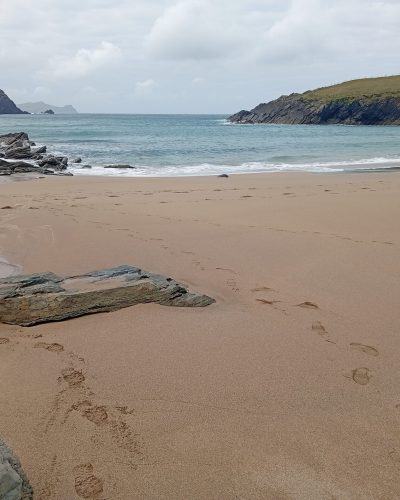
The Dingle Peninsula is located in the westernmost part of Ireland and is known for its stunning cliffs, the islands off the coast, and its magnificent beaches with fine sand.
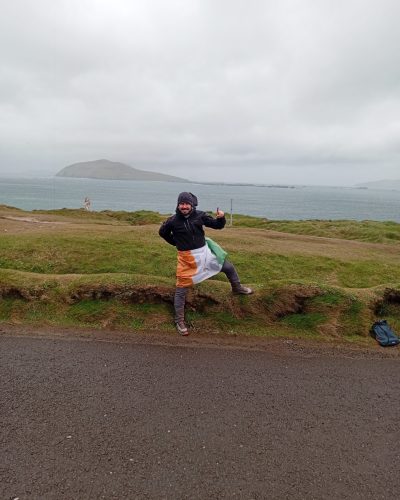
I spend the morning on a circular hike of about 13 kilometers that follows the coastline and offers views of part of the spectacular Blasket Islands. The trail is practically flat, though I was exposed to strong winds while walking it, and you have to be extremely careful on some sections that run along the cliffs, as the wet grass is extremely slippery.
I’m not Irish, so the time I spend in the country is precious. I have to make the most of it. So, even though a 4.5-hour drive to Dublin awaits me at the end of the day, I still manage to squeeze in a quick hike up Mount Brandon—958 meters high—this afternoon, on a route totaling about 10 kilometers. The trail to Mount Brandon starts at about 170 meters above sea level. It’s a straight path and is perfectly marked with numerous signposts all the way to the summit. So, once I’ve left my “old friends”—the wind and fog—behind, I reach the highest point on the peninsula.
I won’t tell you that the views from the top were spectacular because, quite simply, there weren’t any views to speak of. But when the fog decides to stay away, it’s a trip that lets you enjoy all the spectacular scenery the peninsula has to offer. And well, it’s about time to pop my head back out into urban settings… Dublin is waiting for me, and it’s a 4.5-hour trip to get there.
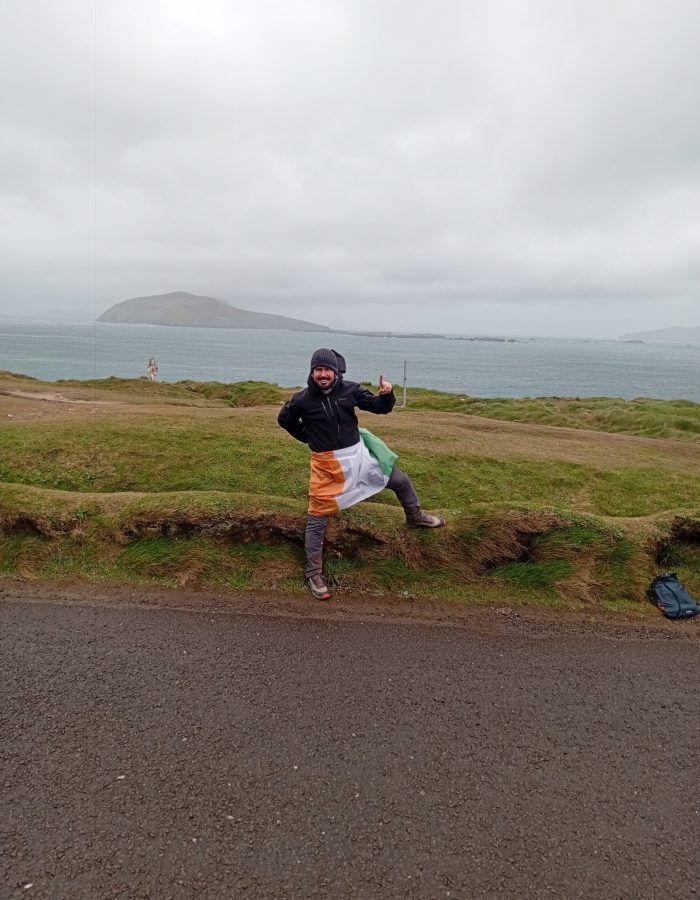
In 2005, I had been in Dublin visiting my childhood friend Bernat Tort, who was studying abroad through the Erasmus program in the university town of “Minute.” Dublin itself isn’t particularly spectacular (aside from its castle), though it is a modern city that has left its Catholic-Protestant conflicts behind to look toward an open, pluralistic, and cosmopolitan future. I recommend taking a leisurely stroll through the city center and popping into a pub to enjoy some traditional “fish and chips” while listening to good music. I spend my last moments in the city strolling through beautiful parks and head out to find my car well in advance to avoid getting caught in the traffic jams that occur during rush hour.
I’ve only spent a few days in Ireland, but they were intense and well spent. They helped me unwind and recharge, since we’d just come off a few months with a heavy workload. World peak number 32 reached. Although Carrauntoohill isn’t particularly high, its weather conditions required our full attention and a good dose of resilience. I’m very happy with the trip and the islands, which always leave a lasting impression.
GALLERY