Tips for travelling to Norway: everything we wish we had known beforehand
Learn from our experience to get the most out of one of the most fascinating countries on the planet. At Top Summits of the World,

Home » The Himalayas: the roof of the world
In Top Summits of the World there are mountain ranges that we admire, others that challenge us and some that transform us. But the Himalayas belong to another dimension. It is not just a mountain range: it is the highest point on the planet, the stage where the most epic, and toughest, pages of modern mountaineering were written.
To speak of the Himalayas is to speak of human limits, of deep spirituality, of tragedies and triumphs, of peoples who live above 4,000 meters and of mountains that exceed 8,000 meters. This chapter is special for us because it represents the maximum horizon of the project: the place where altitude ceases to be a number and becomes survival.
The Himalayas extend for about 2,400 kilometers, crossing five countries: Nepal, China (Tibet), India, Pakistan and Bhutan. In its entrails are concentrated the 14 mountains of more than 8,000 meters of the planet. It is literally the roof of the world.
The Himalayas began to form approximately 50 million years ago, when the Indian plate, which was traveling northward after breaking away from the supercontinent Gondwana, collided violently with the Eurasian plate.
Unlike the Andes, where an oceanic plate sinks under a continental plate, generating volcanoes, in the Himalayas there was a direct collision between two continental masses. Neither of the two plates wanted to give way. The result was a gigantic folding of the earth’s crust, raising layers of sedimentary and metamorphic rock to unimaginable heights.
This compression continues today. The Indian plate continues to push northward, causing the Himalayas to continue to rise millimeter by millimeter each year. This accumulated stress is also responsible for the frequent earthquakes in Nepal, India and Tibet.
The Himalayas are not an ancient, eroded mountain range: they are young, dynamic and still under construction.
Beyond its origin, the geology of the Himalayas explains its extreme morphology. The mountain range is composed mainly of ancient marine sedimentary rocks, limestones and metamorphic shales, which were compressed and uplifted to almost 9,000 meters.
One of the most fascinating aspects is that marine fossils have been found on the summit of Everest, unequivocal proof that these rocks were under the ocean millions of years ago.
Some key data defining its current dynamics:
When we walk in the Himalayas, we are not only ascending a mountain: we are walking on a geological system in permanent tension, where creation and erosion coexist in an unstable equilibrium.
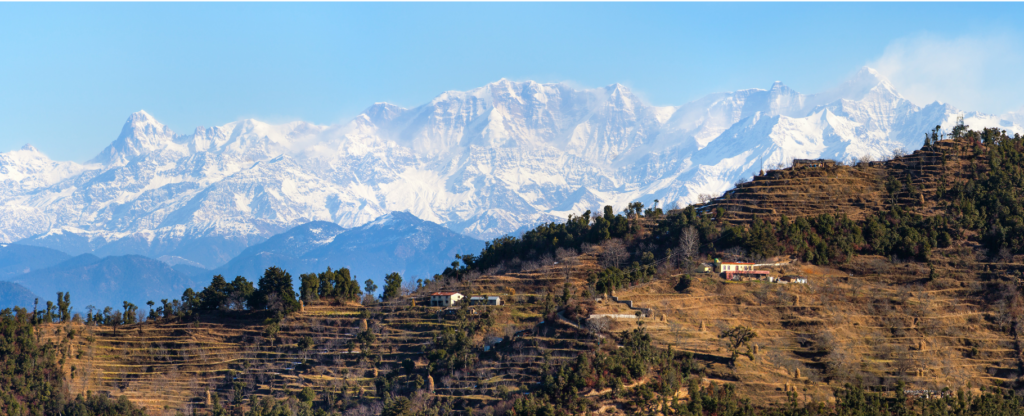
Rhododendron is especially symbolic in Nepal and Sikkim, where the forests bloom bright red in spring.
In the Himalayas, life does not disappear with altitude, it transforms.
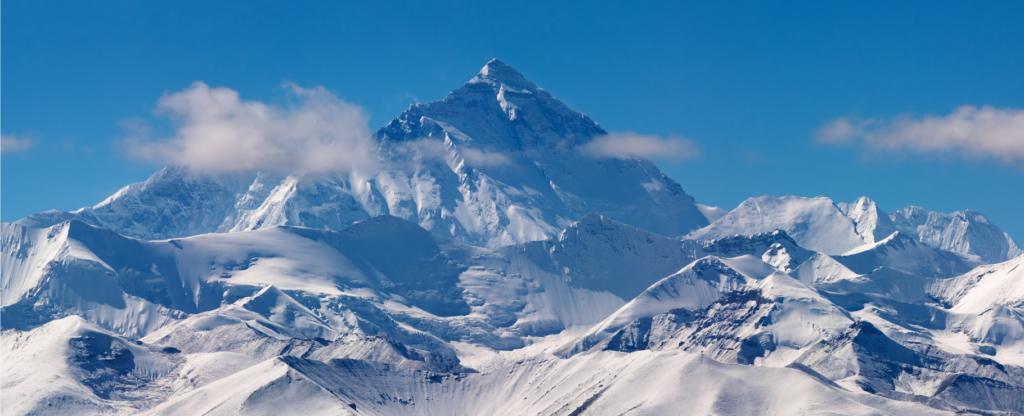
Mount Everest, known in Nepal as Sagarmatha and in Tibet as Chomolungma (“Mother of the Universe”), is not simply the highest mountain on the planet. It is the ultimate symbol of the human limit. Since 1953, when Edmund Hillary and Tenzing Norgay reached the summit, Everest has become the stage where the whole world looks when talking about overcoming.
But at Top Summits of the World we understand that Everest is not a postcard or a record. It is an extreme physiological experience. It is the place where the human body slowly begins to shut down above 8,000 meters. Where every step becomes a conscious decision. Where supplemental oxygen is not luxury, but survival.
Its magnitude is not only vertical, but historical. It has witnessed epic expeditions, massive tragedies such as that of 1996 and ethical debates about the commercialization of mountaineering. It is probably the most documented and photographed mountain in the world, and at the same time, the most misunderstood.
Key features of Everest:
Everest is not only the highest mountain in the world. It is the natural laboratory where the human being discovers how far his own body can resist.
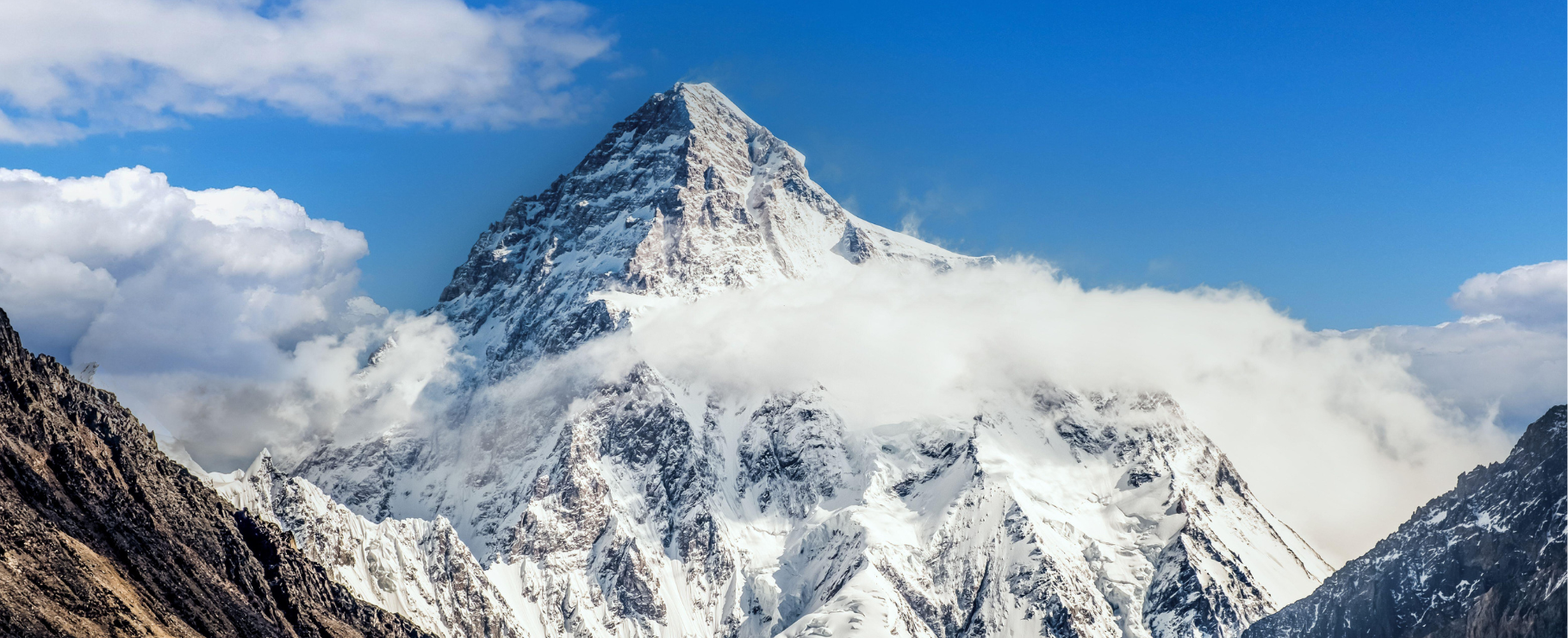
If Everest is the highest, K2 is the most feared. Located in the Karakorum, part of the great Himalayan system, K2 does not have the massification of Everest nor “relatively” accessible routes. It is a raw mountain, technical and demanding in every meter.
Its perfect pyramidal silhouette is deceptive. The slope is constant, the exposure is total and the weather is radically unpredictable. For decades, K2 had a mortality rate of close to 25%, giving it a reputation as an unforgiving mountain.
At Top Summits of the World we see K2 as the mountain of technical excellence. Here, physical endurance is not enough. Here every section requires mastery of ice, rock and mixed climbing at extreme altitude.
Key features of the K2:
The K2 does not allow mistakes or improvisations. It is the mountain where technical mountaineering reaches its maximum expression.
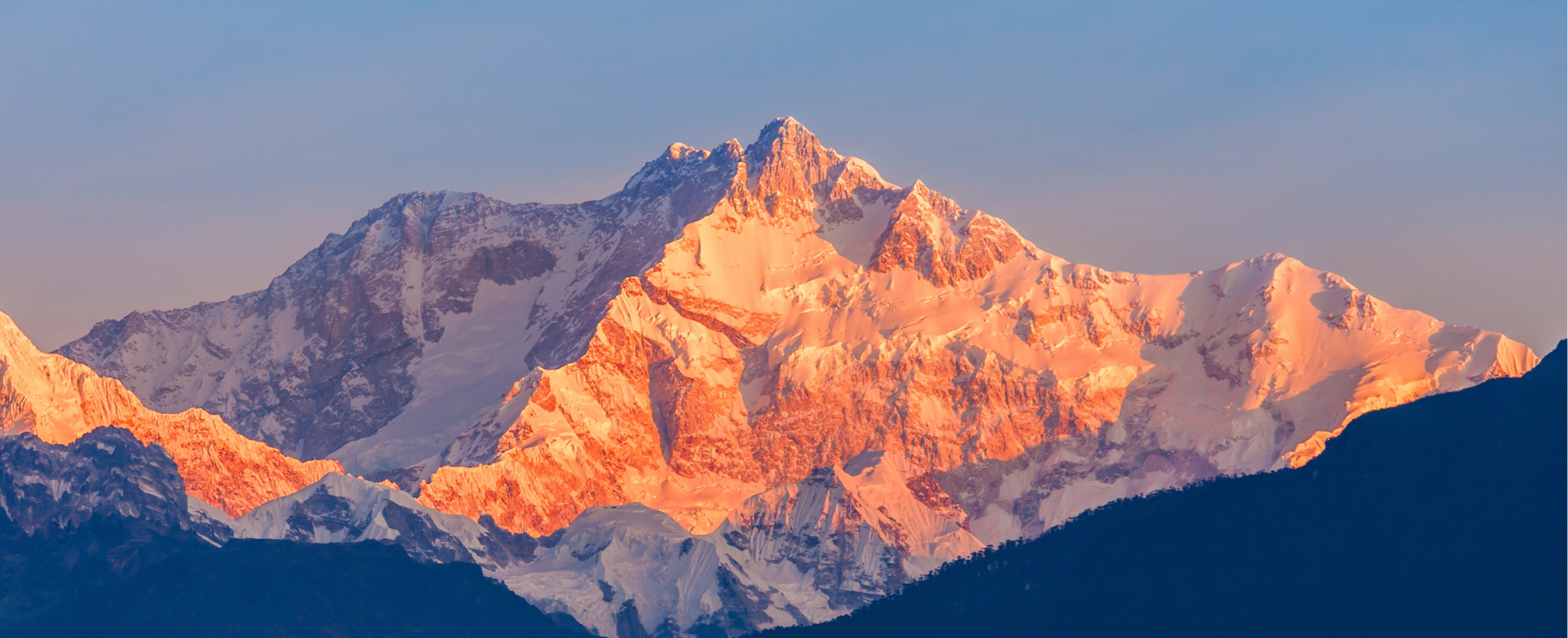
Kangchenjunga, the third highest mountain on the planet, is probably the most spiritual of the eight-thousanders. Its name means “The five treasures of snow”, in reference to its five main summits.
Isolated, less frequented and shrouded in tradition, Kangchenjunga represents a deep connection between mountain and culture. In Sikkim (India) it is considered sacred, and many climbers stop their ascent a few meters before the actual summit as a sign of respect.
From our perspective, it is one of the most authentic mountains in the Himalayas, where experience remains more important than numbers.
Key features of Kangchenjunga:
Kangchenjunga is a mountain where respect weighs as much as altitude.
Lhotse, the fourth highest mountain in the world, lives in the media shadow of Everest, but in technical terms it is a formidable mountain.
It shares much of its route with Everest up to the South Col, but its final section is radically different: the famous Lhotse Wall, an inclined wall of blue ice that demands technique, strength and precision in the middle of the death zone.
From Top Summits of the World, we see Lhotse as the mountain that combines extreme altitude with real technical demand.
Key features of Lhotse:
Lhotse is not a complement to Everest. It is a mountain with its own identity, serious and demanding.
In the Himalayas, the mountain is sacred. It is not a sporting challenge: it is a spiritual entity.
For the Sherpa, Tibetan and Bhutanese peoples, mountains are abodes of deities. Everest is Chomolungma, “Mother of the Universe”. Kangchenjunga is spiritual guardian of Sikkim. In Bhutan, high mountains are officially forbidden to protect their sacredness.
Before each expedition, a puja ceremony is performed to ask permission from the mountain. Prayer flags (lung ta) carry mantras in the wind.
From Top Summits of the World, we understand that climbing in the Himalayas involves integrating into that cultural dimension. It is not only conquering a peak, it is honoring it.
The Himalayas are not only the highest mountain range on the planet; they are also one of the most influential, extreme and fascinating geographical systems in existence. Behind every number there is a geological, climatic or human history that explains why this mountain range is unique.
Nowhere else in the world is there a similar concentration of extreme altitude. The 14 mountains that exceed 8,000 meters, the so-called eight-thousanders, are located in the Himalayas and Karakorum, which is part of the great Himalayan system.
These mountains do not only represent impressive numbers. Above 8,000 meters, the so-called “death zone” begins , where the human body cannot permanently acclimatize due to lack of oxygen. Each of these peaks requires expedition logistics, progressive acclimatization and millimetric planning.
The fact that the Himalayas concentrate all these mountains makes the region the epicenter of extreme altitude mountaineering.
It may seem surprising, but marine fossils and remains of microscopic organisms that lived in ancient oceans have been found on the summit of Everest .
This is because the rock that forms part of Everest belonged to the ancient Thetis Sea, which existed before the collision between the Indian and Eurasian plates. When the two plates collided, the marine sediments were compressed and uplifted to become the world’s tallest mountain.
In other words: when we step on Everest, we are stepping on what millions of years ago was the ocean floor.
The Himalayas not only affect mountaineering, they affect the climate of half a continent.
This gigantic natural wall acts as a barrier that blocks and redirects the humid air masses coming from the Indian Ocean. This phenomenon is key to the formation of the Asian monsoon, which determines rainfall in India, Nepal, Bangladesh and much of Southeast Asia.
Without the Himalayas, Asia’s climate would be radically different. Agriculture, water cycles and the lives of millions of people depend indirectly on this mountain range.
At 7,570 meters, Gangkhar Puensum is the highest mountain on the planet that has never been climbed.
The reason is not technical, but cultural and political. In Bhutan, mountains above a certain altitude are officially closed to mountaineering out of spiritual respect. They are considered the abodes of protective deities.
This fact makes Gangkhar Puensum a unique symbol: a mountain that remains untouched not by physical impossibility, but by cultural decision. In a world where almost everything has been explored, the Himalayas still keep inviolate spaces.
At sea level, the available oxygen allows the body to function normally. At the summit of Everest, the atmospheric pressure is so low that usable oxygen is about 33% of what we breathe under normal conditions.
This causes:
That’s why even elite climbers need supplemental oxygen on most ascents. Himalayan altitude is not just a number: it is a real physiological barrier.
At extreme altitudes, especially above 8,000 meters, the permanent cold and the logistical difficulty make the recovery of bodies extremely complex and dangerous.
Many climbers who die on Everest or K2 remain on the mountain for years or decades. The low temperatures preserve them virtually intact, making them silent reminders of the real risks of extreme altitude.
This aspect, although harsh, is part of the reality of the Himalayas. Here the margin for error is minimal, and the conditions make even rescue operations extraordinarily dangerous.
The Himalayas are not just another mountain range. It is the stage where human beings face their physiological, psychological and spiritual limits. At Top Summits of the World, we know that this chapter is not the end, but the highest peak of our journey. Because it is not only altitude that is measured here. Humility is measured.
The Himalayas cannot be conquered. It is survived. It is respected. It is listened to.
And when our time comes, it will be with the conviction that to climb is not to win, but to understand.
Learn from our experience to get the most out of one of the most fascinating countries on the planet. At Top Summits of the World,

Because recovering properly is just as important as climbing well At Top Summits of the World, we’ve seen it expedition after expedition: you can have
The longest, most diverse and powerful mountain range on the planet At Top Summits of the World, we have explored some of the world’s most