Tips for travelling to Norway: everything we wish we had known beforehand
Learn from our experience to get the most out of one of the most fascinating countries on the planet. At Top Summits of the World,
Home » The Andes: the backbone of South America
At Top Summits of the World, we have explored some of the world’s most iconic mountain ranges, from the snow-capped peaks of the Caucasus to the rugged reliefs of the Atlas Mountains. But the Andes command a special respect. Not only because of their colossal scale, the longest on the planet, but also because of their ability to cross continents, cultures and ecosystems. Here, the mountain is not only geography: it is history, it is life, it is identity.
More than 7,000 kilometers long, the Andes range runs from north to south across South America, from the shores of the Caribbean to the cold confines of Patagonia. But what really captivates us about this mountain range is not only its length, but the intensity of each stretch, the diversity of its peaks and the symbolic depth of each step between its snows, rocks and valleys.
In this new chapter, we share a panoramic view of the Andes, its geological, cultural and natural characteristics, and delve into the highest peaks of six Andean countries: Colombia, Ecuador, Peru, Bolivia, Bolivia, Chile and Argentina.
The Andes stretch along the western coast of South America, starting in Venezuela and crossing Colombia, Ecuador, Peru, Bolivia, Chile and Argentina before merging with the southern plateaus of Patagonia. This enormous geographic extension makes them much more than just a mountain range: they are a set of systems that vary in shape, altitude, climate and ecology.
Broadly speaking, the Andes can be divided into three main sections:
This uniqueness gives them an enormous climatic diversity: from tropical zones near the equator to glacial regions in the south; from the extreme aridity of the Atacama Desert to cloud forests, passing through inter-Andean high plateaus of 4,000 m altitude.
For us at Top Summits of the World, the Andes are a mountain range of contrasts, where each stretch has its own character, history and challenges.
The Andes are the result of the subduction of the Nazca plate under the South American plate. This tectonic process, active for tens of millions of years, has created enormous mountain ranges, active volcanoes, deep faults and an extremely complex relief.
Unlike other mountain ranges formed mainly by continental collisions (such as the Himalayas), the Andes are the product of oceanic-continental interaction. The Nazca plate beneath South America forces the crust to uplift, fold and fracture. The result: a huge mountain belt that consistently exceeds 6,000 meters in many places.
This process has also generated an extensive volcanic chain: the Andean Volcanic Belt, with dozens of active and inactive volcanoes that build the mountainous route from Colombia to Chile.
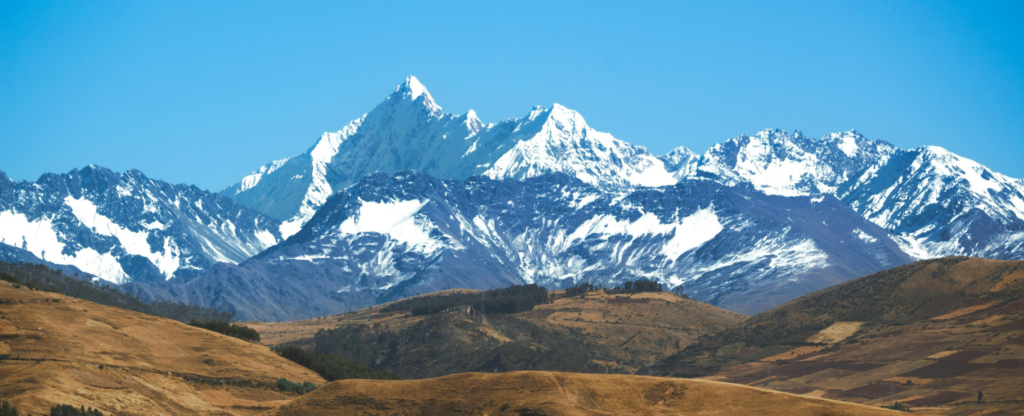
The Andes are home to an amazing variation of vegetation, depending on latitude and altitude:
Plants such as ichu, queñua, polylepis or the emblematic puya raimondii are examples of extreme adaptation to cold, dryness or altitude.
The Andes are also home to unique species:
For us, this biodiversity is not just a visual complement: it is an essential part of understanding the mountain as a living ecological environment, not as an inert mass of rock and snow.
The Andes are home to some of the highest mountains outside of Asia, with peaks that challenge the limits of modern mountaineering. Here are the most emblematic peaks of the Andean system:
Aconcagua is the undisputed roof of South America and the highest mountain in the world outside Asia. Its imposing presence in the main mountain range of the Argentinean Andes, its relative accessibility and its history make it a true icon of world mountaineering. For many mountaineers, it represents their first “six thousand” or even their first step on the Seven Summits circuit.
From Top Summits of the World we see Aconcagua not only as a high altitude, but as a mountain that exposes the climber to real conditions of extreme altitude, complex logistics and a constant struggle against wind, cold and self-sufficiency.
Key characteristics of Aconcagua:
Aconcagua does not require climbing techniques on its normal route, but the altitude and environment make it a serious mountain, where every mistake has real consequences. It is, without a doubt, the great summit of the Andes, and one of the most formative challenges for any mountaineer who dreams big.
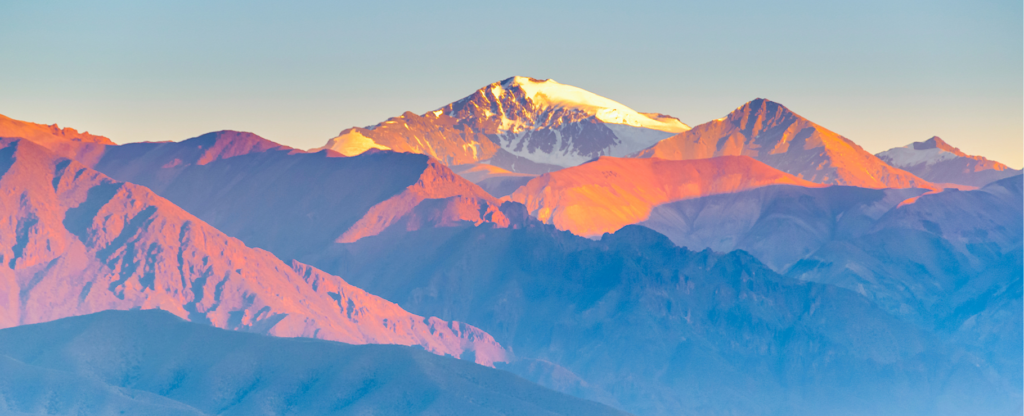
Pico Cristóbal Colón, together with its twin Simón Bolívar, is the highest mountain in Colombia and one of the most surprising in the entire continent, not so much for its altitude, but for its location: in the middle of the Sierra Nevada de Santa Marta, just 42 kilometers from the Caribbean Sea. It is the highest coastal mountain in the world, and its isolation makes it one of the most remote in South America.
Key features of Christopher Columbus Peak:
Chimborazo is Ecuador’s highest peak and a monumental volcano whose silhouette dominates the central Andes. Although it is not the highest mountain in the world, its equatorial position makes it the closest point to the sun from the earth’s surface, due to the equatorial bulge.
Key characteristics of Chimborazo:
The Huascaran Sur is the roof of Peru and one of the most majestic peaks of the Cordillera Blanca. This snowy massif not only imposes for its height, but also for the symbolism it has in the heart of the Andean culture and the history of mountaineering in the country.
Although Huascarán Sur is one of the most emblematic mountains in the Andes, it is also considered one of the most dangerous peaks in South America. The main reason is not its technical difficulty, but the objective risks: frequent avalanches, collapse of seracs, unstable crevasses and rapid changes in glacier conditions.
Key characteristics of Huascarán:
Nevado Sajama is the highest point in Bolivia and a dormant volcano that rises in the Altiplano, near the border with Chile. Its perfect conical shape and its surroundings of geysers and hot springs make it an almost mystical place.
Key characteristics of Nevado Sajama:
The Ojos del Salado is the highest volcano on the planet and the highest point in Chile. Its ascent, although not technical, presents the extreme challenge of altitude, aridity and logistics in the middle of the Atacama Desert.
Key characteristics of Ojos del Salado:
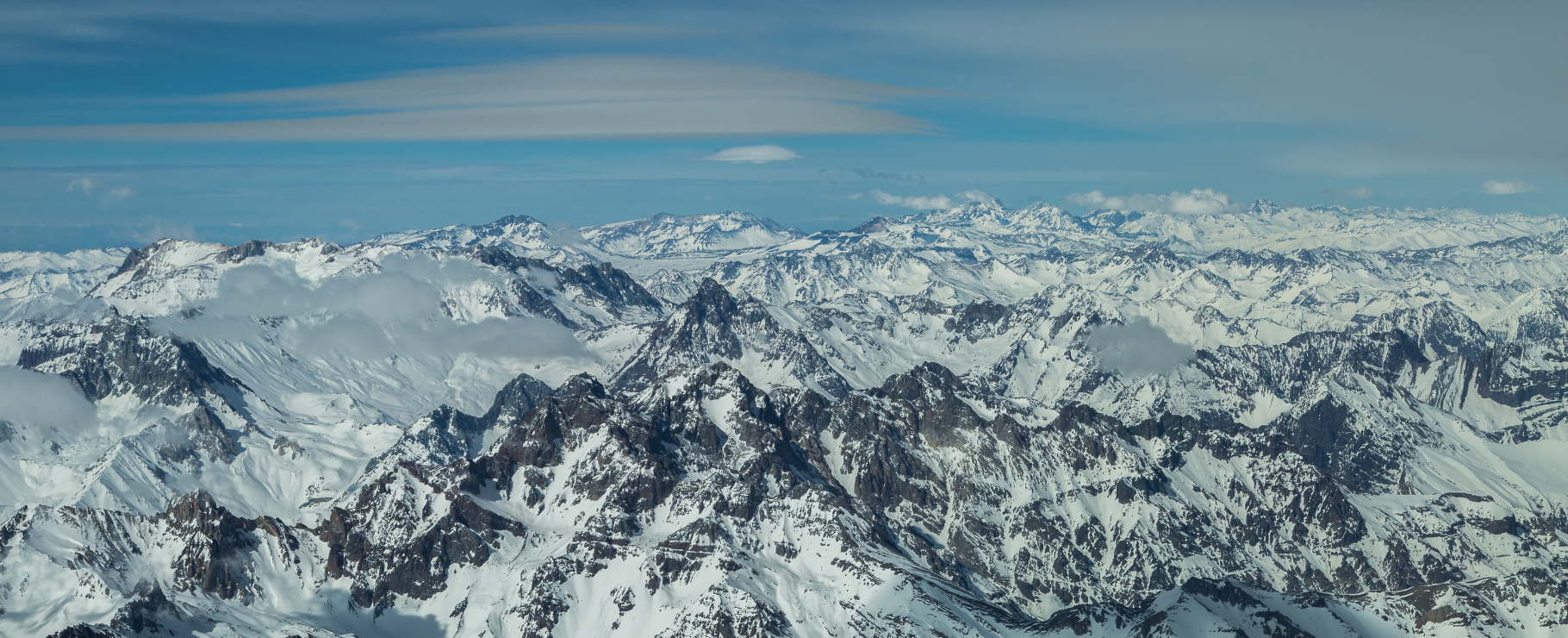
Nowhere else in the world have we felt the spiritual bond between people and the mountains as present as in the Andes. For the native Andean peoples, the peaks are not mere geographical features: they are apus, tutelary deities that protect the communities.
Since pre-Inca times, mountains have been considered sacred places, pilgrimage centers, spaces for ritual offerings and also guardians of the natural balance. In many cultures today, this respect persists: permission is sought from the mountain before climbing, offerings are left, and its power is honored.
Throughout the altiplano and the inter-Andean valleys, Quechua, Aymara, Mapuche and many other communities coexist with the landscape in symbolic and practical ways. Their textiles, music, legends and architecture are shaped by the Andean environment. At Top Summits, we cannot conceive of an expedition without also immersing ourselves in this deep cultural dimension.
The Andes mountain range is not only a geographical challenge for those of us who love the peaks: it is a vital system that shapes the climate, culture, history and spirituality of an entire continent.
From Top Summits of the World we feel a deep admiration for every stretch of the Andes. Whether it is the Bolivian altiplano, the Cordillera Blanca of Peru, the Ecuadorian massif or the southern slopes of Patagonia: in every corner there is a lesson, an unrepeatable landscape and a community that lives with the vertical.
Climbing to its highest peaks is only part of the journey. What really transforms us is the whole: the mixture of extreme nature, ancestral culture and personal challenge. In that, the Andes have no equal.
This is a fundamental chapter in our project. And we know we will be back.
Learn from our experience to get the most out of one of the most fascinating countries on the planet. At Top Summits of the World,

Because recovering properly is just as important as climbing well At Top Summits of the World, we’ve seen it expedition after expedition: you can have
Where the Earth touches the sky In Top Summits of the World there are mountain ranges that we admire, others that challenge us and some