SUMMITS
SUMMIT Nº 24: SLIEVE DONARD (NORTHERN IRELAND)
NORTHERN IRELAND

SLIEVE DONARD

16/05/2025
ALTITUDE
850 m

MARIA FUSTÉ AND ANDREU LÓPEZ

DIFFICULTY LEVEL
LOW
CHRONICLE
It’s not even been a month since the TSOW team was driving in the left lane while discovering the Republic of Cyprus. We’re landing back on British soil. After trips to Cyprus (2025), Malta (2024), Wales (2023), and Scotland (2018), we’ve more than qualified to be worthy of the “Most Excellent Order of the British Empire.”
The plane leaves Reus for Belfast with the low-cost airline Jet2, with Maria Fusté joining the project, as she had never been part of the TSOW expedition. It seems like it will be a departure with novelties and firsts, as we’ve never flown from Reus or with Jet2, a low-cost airline based in Leeds.
While we wait for the 11:50 flight LS304 to Belfast, I receive some bad news over the phone. The death of a young person, and in the time we shared and coincided, I was able to discover a great professional and, above all, a great person. It’s a huge loss, and I’m in shock for a while, assimilating and digesting the terrible news.
Maria Fusté is someone who makes the best teams, and on the nearly three-hour flight to Belfast, we enjoy a delicious poke bowl at 10,000 meters above sea level. In my case, it’s made of chicken and celery with a delicious soy sauce. The flight passes quickly between lunch and a walk along the Nile (I’m immersed in reading “Death on the Nile” by the brilliant and brilliant Agatha Christie, the queen of crime). I place the landing in Belfast in the top three worst landings I’ve ever taken part in, although this is offset, once we get off the plane, by a spectacular sun, definitely more Mediterranean than British.
We have a very full tour program, which we have organized and prepared very well with Maria, working excellently as a team. We quickly head to the Europcar offices, where our Volkswagen VW Golf Hat is waiting for us. It’s the smartest car with the most built-in sensors and technology I’ve ever driven, and it will be a great ally on our adventure.
Our apartment is in a prime location. We are staying in the Titanic Quarter, and the windows offer fantastic views of the River Lagan and its final kilometers to its mouth. We choose the River Lagan to take our first steps in Northern Ireland and enjoy a lovely walk alongside it until we reach the botanical garden, which exudes a bustling atmosphere. It’s clear that Belfast residents aren’t used to cloudless, sunny days like this, and judging by the number of people in the park, it seems the day has been declared a National Day (football matches, cricket games, skipping, frisbee, naps… the repertoire is extensive).
After a pleasant walk through the botanical garden, Maria, who could easily be a tour guide, leads us through the main monuments of the historic center. We enjoy a city whose buildings and structures perfectly combine the past with the future, alternating between buildings with avant-garde designs and more classic ones with typical brick facades. Speaking of avant-garde areas and renovated neighborhoods, don’t miss the Titanic Quarter and a leisurely stroll to the Titanic Museum. Interestingly, Belfast has one of the largest shipyards in the world, where the Titanic was built between 1909 and 1912. Unfortunately, we’re all familiar with the story that follows, and its fatal ending.
It’s 7:30 p.m. and it’s late, late for the Northern Irish when it comes to dinner time, so we head back downtown and find a place that seems right. We don’t linger too long over dinner, as at 8:30 p.m. we have more than just a derby to watch. Espanyol and Barça face off at Cornellà El Prat, and if Barça emerges victorious, they will clinch their 28th league title and seal a fantastic season in which, in August 2024, achieving such a result seemed unthinkable.
After trying three or four different sports bars, we gave up. Brits prefer drinking to watching, and we couldn’t find a single screen with a green screen anywhere, so we decided to retreat to the apartment. Tomorrow we have an intense day of sightseeing, highlighting the climb to Slieve Donard and the Coastal Route, with stops at various castles and sandy beaches along the more than 120 miles of road.
The alarm goes off early, and we have the bread and cheese we bought yesterday at the supermarket for breakfast. We leave at 8:30 for the Mourne Mountains (the region that inspired the Chronicles of Narnia), where Slieve Donard is located, which at 850 meters is the highest elevation in Northern Ireland.
We started around 10:00 a.m. on a completely sunny day with no threatening clouds on the horizon, a completely unusual and surprising occurrence considering the “islands.”
The route begins practically at sea level, and although we travel parallel to it, it’s disappointing to complete the first 3-4 kilometers of the route on the road and in constant vehicle traffic. Cautiously, we make progress and try to stay as far away from the road as possible.
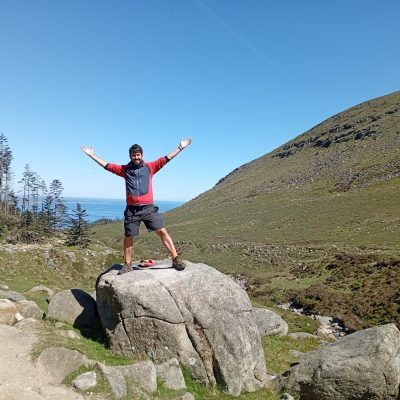
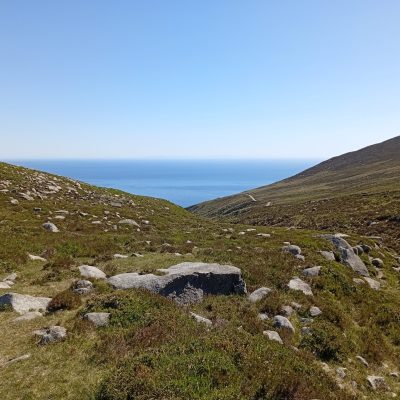
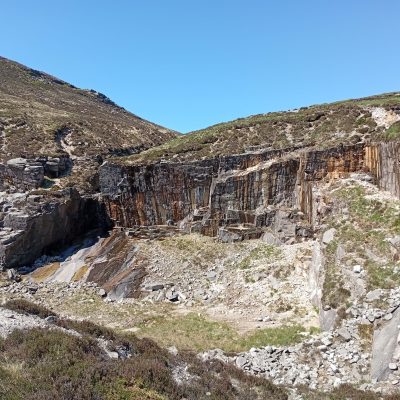
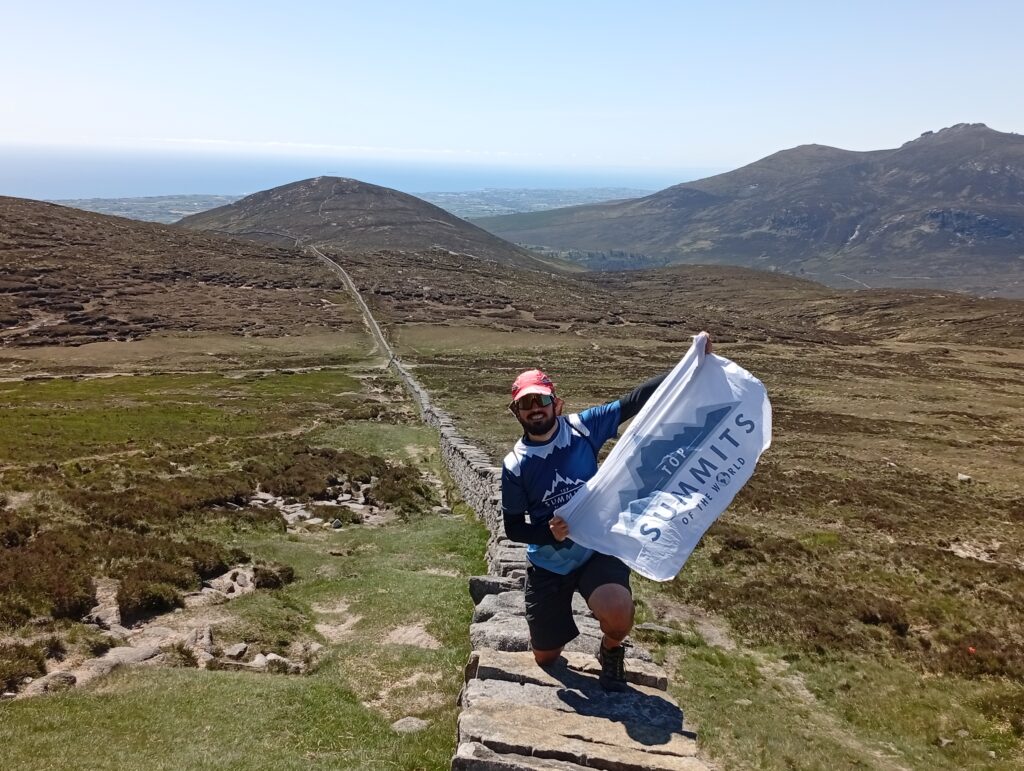
After passing the initial road toll, an open wooden gate awaits us on the right, welcoming us to the Mourne Mountains, along with a beautiful river that runs parallel to our trail. The trail and the river continue hand in hand for 3 kilometers until we reach the pass, located at about 450 meters, which represents half of the day’s 850 meters of elevation gain. The pass, in addition to marking the halfway point of the ascent, presents a curious alteration to the landscape in the form of a spectacular 30-kilometer stone wall intended to prevent livestock from accessing the reservoir area and contaminating the water.
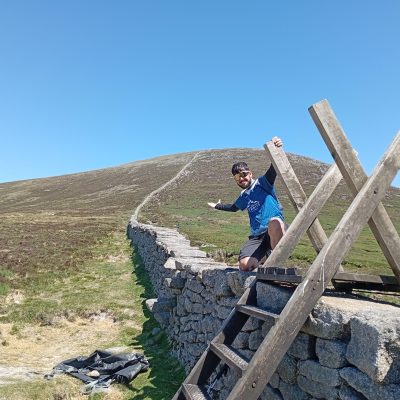
This way of doing things completely in reverse of the British way of life, we get hooked, and we ignore the path that leads to the summit and decide to walk over the stone wall. In this world we live in, if you don’t stand out from the rest, you’re a nobody.
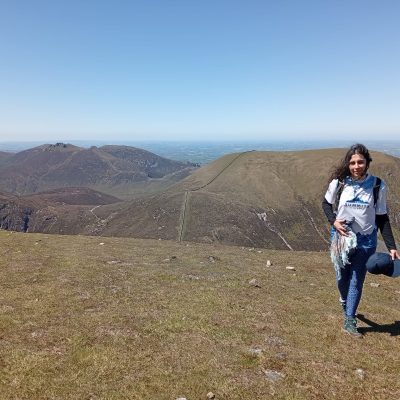
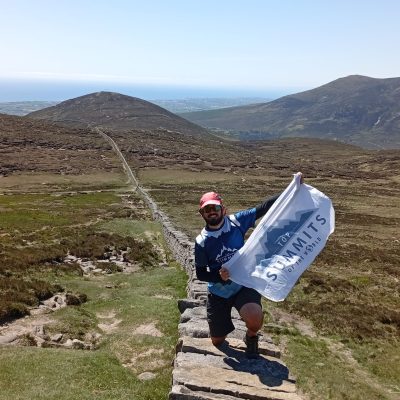
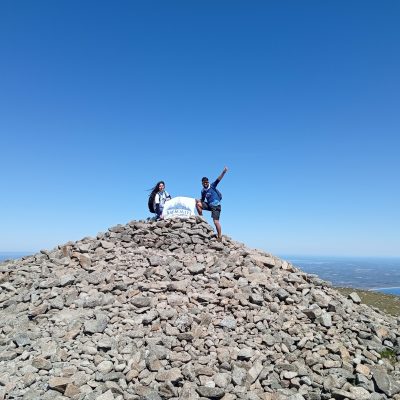
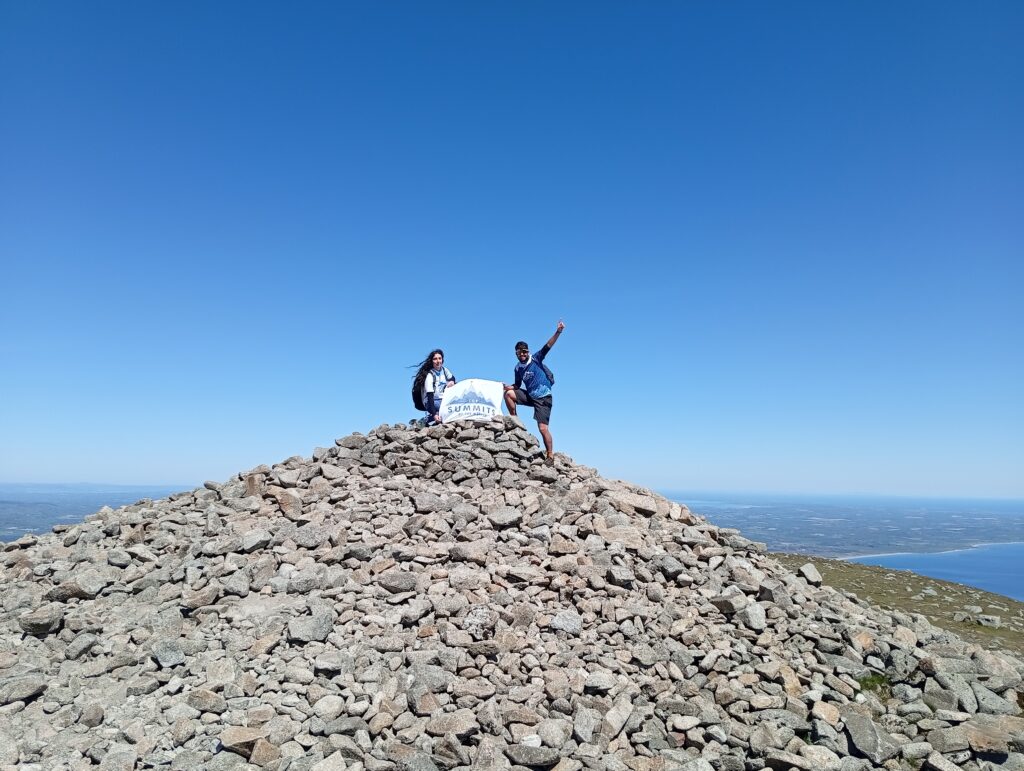
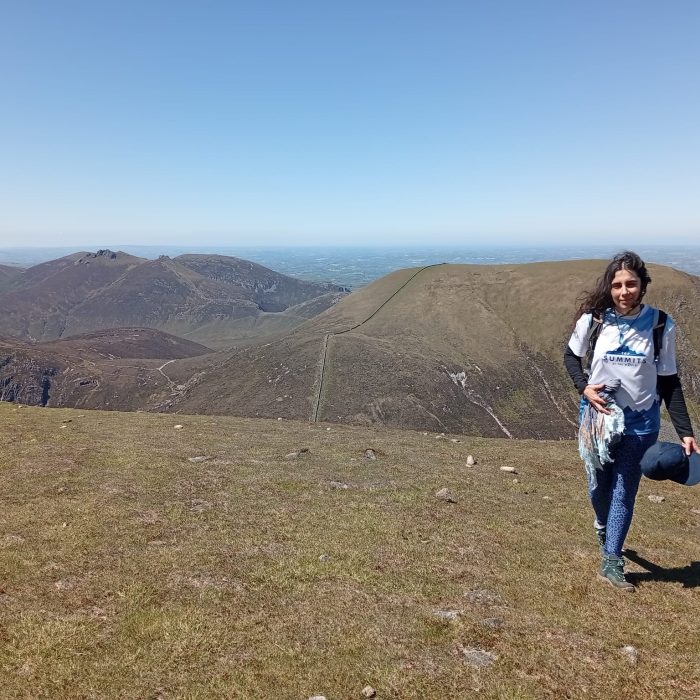
We had a great time climbing the rock face, as it’s not every day that one gets to walk over a rock wall almost 2 meters high. Before we knew it, we reached the 850-meter peak of Slieve Donard, which offered us spectacular 360-degree views and even allowed us to see the Isles of Man on the horizon. This is Maria’s second world summit after the one recently reached in San Marino and her first within the TSOW project, and I congratulate her. She’s not used to completing 850 meters of positive altitude regularly, and the truth is that she did very well, with great determination and attitude toward the challenge ahead. We immortalized the moment with the TSOW flag, which is universal and knows no barriers, confrontations, or political differences, as its purpose is to unite the world through its world summits.
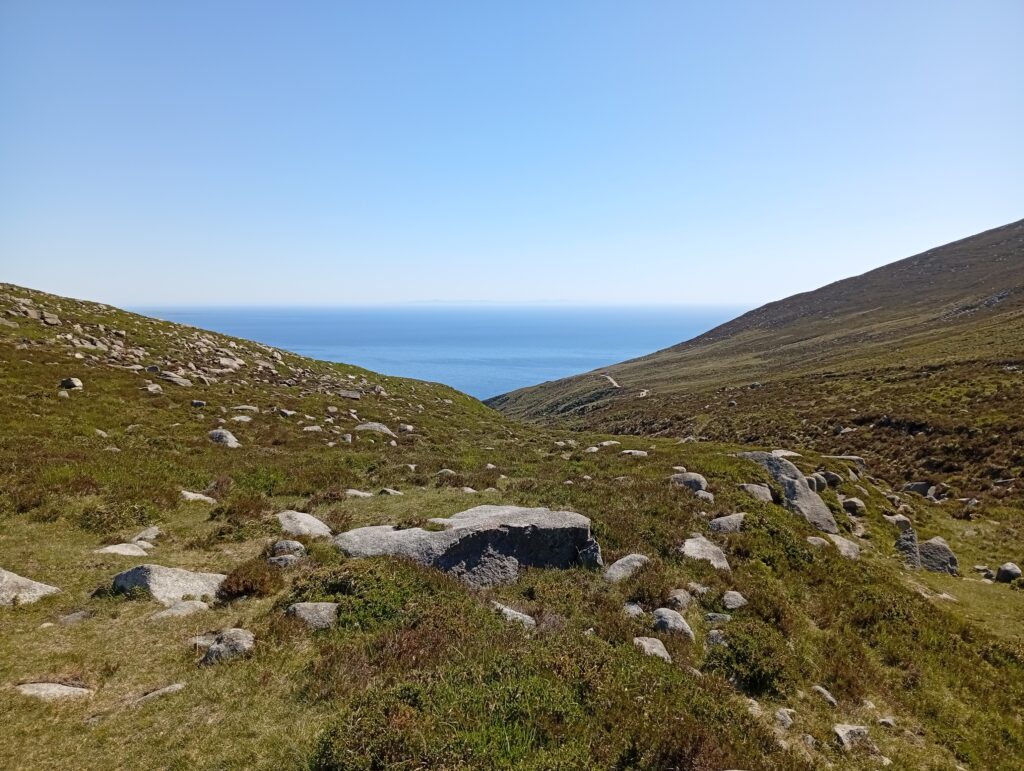
The route is circular and doesn’t repeat the path, although after the summit, the “Northern Ireland Wall” continues. This time, in a more civilized way, we walk along the path parallel to it and reach another pass. From this pass, the sea can already be seen, so around 3:30 p.m., we complete a beautiful 13.5-kilometer hike with a positive elevation gain of 879 meters.
The 13.5 kilometers and 879 meters of elevation gain exempt us from further exertion of our legs for the rest of the day, and we hand over to our vehicle. The afternoon’s purpose is purely contemplative, aiming to enjoy the “Coastal Road” and its well-preserved castles, stopping on sandy beaches and putting our legs in the water, enjoying the sunset… until we reach Ballycastle, a very pretty coastal town that will be our “roof” for this second night.
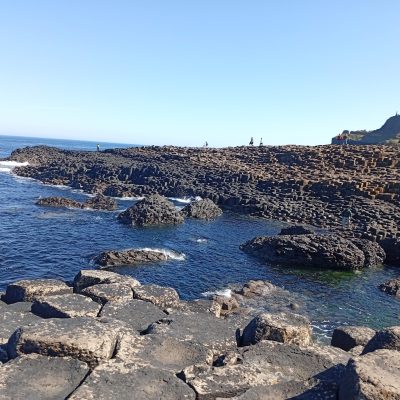
Day 3. We are now halfway through this short but intense 4-day getaway through Northern Ireland. Today’s program also features a significant concentration of activities, so we have breakfast in our room and leave around 8:30 for the “Giant’s Causeway.” It is a group of approximately 40,000 interlocking basaltic columns, the result of a volcanic eruption that occurred approximately 60 million years ago. The tallest columns are 12 meters high, and in 1986, the area was declared a UNESCO World Heritage Site.
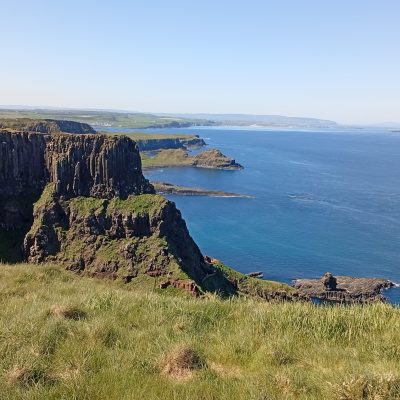
It is one of the most popular tourist spots in the country, and, given that it is a Saturday, there are large crowds at the points where the columns are most prominent. However, as we move further away, we can enjoy a peaceful route through the brutal and rugged cliffs that define the Northern Ireland coastline.
The next stop after the Giant’s Causeway is Derry. It’s time to share a little history about this city. Between August 12 and 14, 1969, the “Battle of the Bogside” took place. This was a series of clashes in the Bogside neighborhood of Derry between residents of the Catholic neighborhood and the police (the Royal Ulster Constabulary, RUC). These events led to a series of social disturbances that culminated in the creation of a self-proclaimed autonomous area (“Free Derry”), which remained under the control of Irish nationalists until 1972. On January 30, 1972, on “Bloody Sunday,” 13 unarmed men and boys were killed in the city by British paratroopers after a pro-Civil Rights demonstration by Catholics in Northern Ireland in the Bogside neighborhood. So we spent Saturday afternoon exploring the history of Derry, a city whose murals and memorials bring events that aren’t so distant in time to the present. As we wandered through Derry’s Old Town, we were surprised by a major, crowded argument, with the occasional punch thrown, between security personnel and people with a higher concentration of alcohol than blood in their veins. It’s impossible to imagine Northern Ireland without beer, just as beer cannot be imagined without Northern Ireland. We had dinner and went to bed, lest we be caught in the receiving end and the innocent pay for the guilty.
It was Sunday, and we got up early. We fit in a visit to “The Dark Hedges,” one of the most magical and fairy-tale corners of Northern Ireland. It’s an intricate avenue of enormous beech trees that was chosen as the setting for “Game of Thrones.” Over the past 300 years, the beech trees lining both sides of the road have curved inward in an almost surreal way, intertwining with each other to create a natural arched tunnel, creating wonderful interplays of light and shadow between the branches.
At 2:00 PM, we have to be at the Europcar offices to return the vehicle, so we have a few hours left in Northern Ireland, and we use them to do some souvenir shopping in downtown Belfast. We bid farewell to Northern Ireland and say goodbye to TSOW, whose next stop will be in just over a month. Thank you, NIR. See you soon, Armenia.
GALLERY