The Atlas: the Maghreb mountain range between the Sahara and the Mediterranean
A journey through the Atlas, guardians of the desert and the mountains At Top Summits of the World we have traveled mountain ranges that cross
Home » The Caucasus: the natural wall between Europe and Asia
In Top Summits of the World, we feature mountain ranges that challenge us with their altitude, others with their history or symbolism… and then there’s the Caucasus, a mountain range that seems to combine everything: height, legend, political complexity, and untamed beauty. Located between the Black Sea and the Caspian Sea, and on the natural border between Europe and Asia, the Caucasus has been for centuries a dividing line, and at the same time a meeting point, between civilizations.
In this new chapter of our saga of great mountain ranges, we delve into one of the most complex and fascinating regions in the world, home to some of the continent’s most impressive peaks. And as you’ll see, we’ve already set foot on some of its summits.
The Caucasus Mountains stretch for approximately 1,100 kilometers from the Black Sea coast to the Caspian Sea coast, traversing territories of Russia, Georgia, Armenia, and Azerbaijan, as well as autonomous regions and republics with great ethnic and cultural diversity.
It is divided into two main sections:
Geologically, the Caucasus is the result of the collision between the Arabian and Eurasian plates, a process that continues today and is slowly raising the mountain range. This collision has given rise to young mountain folds, volcanic formations, active faults, and significant seismic activity.
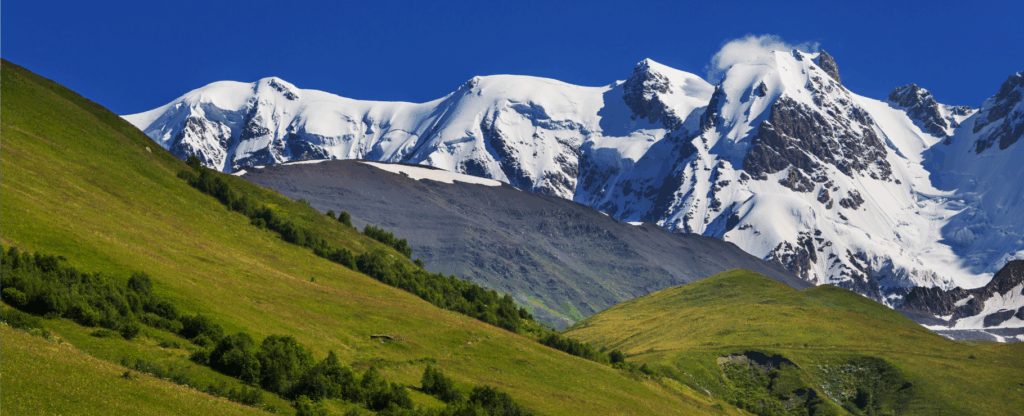
The Greater Caucasus is the most recent and rugged, with peaks exceeding 5,000 meters, active glaciers, and sheer walls of metamorphic rock and granite. In contrast, the Lesser Caucasus is older, with dormant volcanoes, rounded hills, and eroded plateaus.
In our experience, the Caucasus Mountains are not like the Alps or the Atlas Mountains: the terrain here is wilder, less defined, and often lacks established trails. This makes them even more appealing to those of us seeking the mountains in their purest form.
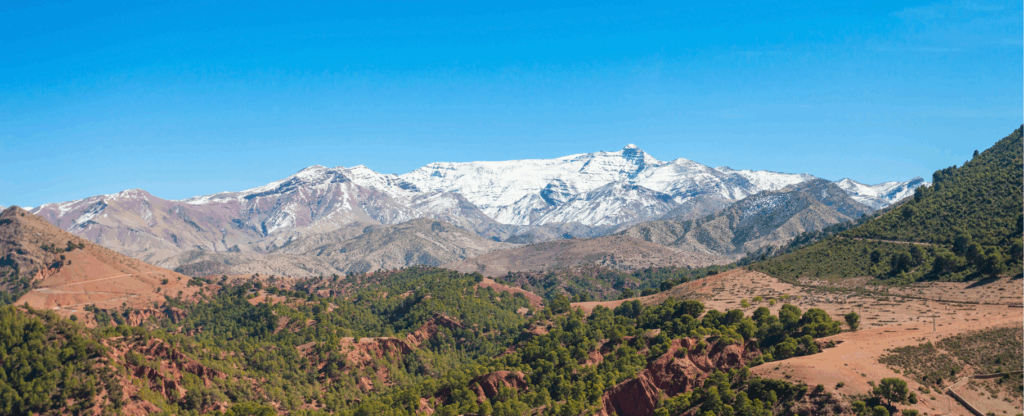
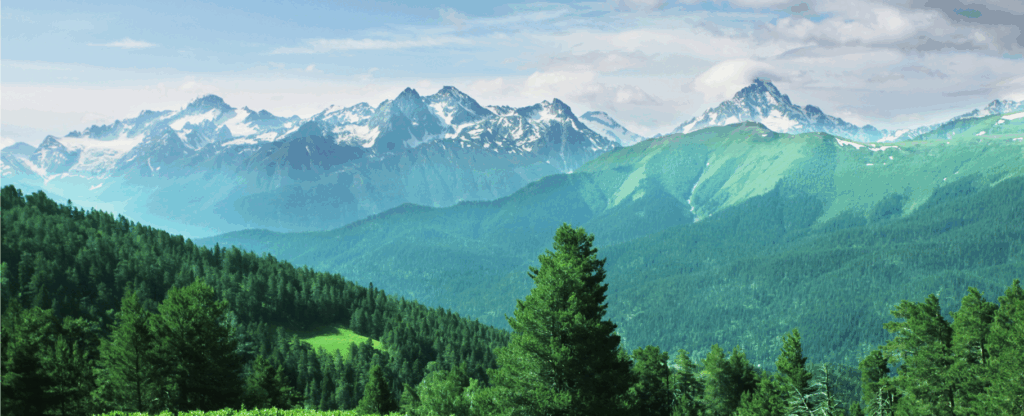
Although less well-known than other mountain regions in Europe or Asia, the Caucasus Mountains are home to exceptional biodiversity, especially in areas such as Svaneti (Georgia), Kabardino-Balkaria (Russia), and Dilijan National Park (Armenia).
Climbing to the Caucasus means experiencing nature largely untouched by human activity. Human beings. And that’s evident in every footprint, every sound, every glance exchanged with a mountain goat or an eagle soaring through the air.
Below, we present the most iconic peaks of each country in the Caucasus. Some are already part of our Top Summits of the World route, and others are on our list of challenges to conquer.
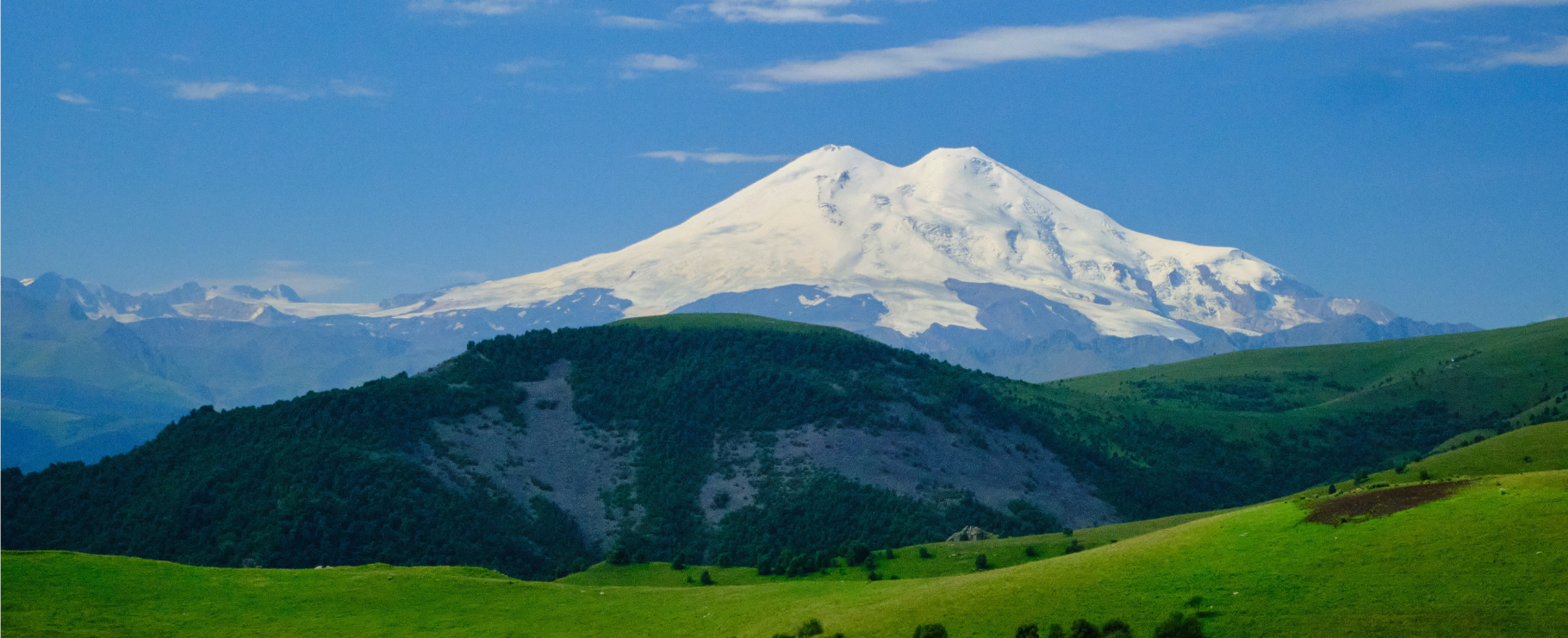
Elbrus is the roof of Europe (according to the most widely accepted geographical boundaries) and one of the highest peaks of the Seven Summits. It is an extinct double-peaked volcano, covered in permanent glaciers and with extreme conditions of wind, snow, and altitude.
Although we haven’t yet climbed it, Elbrus is very much on our minds at Top Summits of the World. It will be one of the culminating stages of our continental traverse.
Shkhara is the highest mountain in Georgia and one of the most technically challenging climbs in all of Europe. It forms part of a colossal ridge known as the Bezengi Range, which also includes Janga and Ushba, another giant of the Caucasus.
Shkhara represents the essence of technical mountaineering in the Caucasus. It is a challenge we have yet to take on, but one we contemplate with respect and admiration.
The highest mountain in Azerbaijan is located on the border with Russia, within the East Caucasus. Its name means “high market” in Azerbaijani, and although it is not as imposing as Elbrus or Shkhara, it is a very interesting summit for those seeking adventure without excessive technical difficulty.
We have this peak clearly marked as an achievable objective within the Caucasus region. A summit that combines challenge and discovery.
Mount Aragats is the highest peak in Armenia and an extinct volcano that dominates the country’s landscape. It has four main summits, with the northern summit being the highest. Its surroundings are of volcanic origin, with craters, high-altitude lakes, and remnants of snow even in summer.
The Caucasus is not just a mountain range: it is a mountainous Tower of Babel. More than 50 different languages and dialects are spoken here. Each valley has its own history, its own legends, its own way of understanding the world.
On every expedition, at Top Summits of the World, we’ve discovered that climbing a mountain in the Caucasus is not just a physical feat: it’s an immersion into centuries of history.
Few Mountain ranges command as much respect as the Caucasus. It is a land of contrasts: glaciers and deserts, Orthodox faith and Sufism, technical mountaineering and easy hiking. At Top Summits of the World, we have already experienced some of its peaks and continue to plan new ascents, because this mountain range has it all: altitude, identity, history, and challenge.
The Caucasus is not just a boundary between continents: it is an invitation to cross them.

A journey through the Atlas, guardians of the desert and the mountains At Top Summits of the World we have traveled mountain ranges that cross

A journey through Europe’s most iconic mountain range At Top Summits of the World, we are clear that if there is a mountain range that

A tour through a magical, wild and historical mountain range At Top Summits of the World, we’re passionate about heights, but also about the stories