SUMMITS
SUMMIT Nº 26: Gerlachovský štít (Slovakia)
Slovakia

Gerlachovský štít

10/08/2025
ALTITUDE
2.655 m

ÁLEX QUIROGA AND JORDI GIRONA

DIFFICULTY LEVEL
HIGH
CHRONICLE
The plane to Milan Malpensa Airport leaves at an unfriendly hour (7:55 a.m.), so to avoid starting the trip on the wrong foot and tormented by lack of rest, I opt for a hotel near El Prat Airport. At 5:15 a.m., the taxi I’d reserved picks me up, and at 5:35 a.m. I’m already at Terminal B at El Prat Airport, where in just over two hours we’ll be flying to Italy with Jordi Girona, although I’ll also refer to him from now on as “xec.” “Xec” isn’t a bank check, nor does it refer to Jordi Girona being originally from the Czech Republic. “xec” is a term used in Tarragona that has been preserved to refer to someone close to us and is used in colloquial contexts.
Jordi Girona, from the lands of Tarragona and the Selva del Camp, a true native of the Camp (don’t let his surname confuse you), arrives punctually at 5:40 a.m. at Terminal B. We head to the EasyJet counters to check in our luggage. The next step, going through security, also moves smoothly, so we arrive at the boarding gates well in advance. The flight to Milan-Malpensa takes just under two hours, which we take advantage of to rest a bit, since both of us, plus him, are short on sleep time.
At Milan-Malpensa, we land at Terminal 4, although we have to take a bus to take us to Terminal 5, where we’ll have to repeat the sequences we completed a few hours earlier at Barcelona Airport. We go to the Ryanair counters to check in our luggage, validate our ticket and go through security checks. While we wait for the plane to Bratislava (Slovakia), we take a few bites of some delicious pizzas. When it comes to the art of pasta, the Italians are the true kings.
The Milan-Bratislava flight is similar to the first one in terms of the journey time, which takes less than two hours, which I take advantage of to read. On this trip, I brought and will be accompanying a couple of books: “Seven Years in Tibet” (a brutal adventure of two prisoners of war who travel 2,500 kilometers to reach Lahsa, the capital of Tibet, and establish relations with the Dalai Lama himself), as well as Cristina Martin Jiménez’s non-fiction novel “The Owners of the Planet” (12 chapters dedicated to 12 of the most powerful and influential people on the planet and their peculiar and particular modus operandi).
Bratislava’s airport, being the capital of the country, is very small, which already gives us an idea of the low tourist pressure that Slovakia receives. One of my biggest worries when starting a trip is not having my luggage arrive (since it’s very expensive, and I’ve already had more than one bad experience in some countries), although luck favors me and mine is one of the first to appear on the carousel.
Xec will be the “boss” of the car. That’s what he wanted, and for me, who dislikes driving more than I like it, it seems fantastic and I don’t offer any resistance. The arrangements with Europcar (the car rental company I’ve been using lately) are quick and without excessive delay, and we head to the Ibis Centrum (our hotel located in the center of Bratislava).
After settling in and resting a while, we head out to stretch our legs in the city center, which, while not very large, is very charming. We extend the walk to the Danube and around 7:00 p.m. we head to a local restaurant to discover the local cuisine.
Our stomachs are full and it’s not too late yet, so we’re going to have a drink and plan our program for the next few days. The next day will be a transition day, with a four-hour drive to the Tatras, this brutal mountain range that will be our “home” for the next few days. Landing in the Tatras will begin with the main stage, as on Sunday, Kuba, our local Polish guide, will be waiting to drive us to the top of the country, Gerlachovský štít, and from there, “Gerla,” to make everyone’s life easier. Jordi’s beer and my Coca-Cola give us enough time to finalize coordinating aspects related to equipment, the route to follow, and the mountain guide. It’s not too late, but our eyes have been open for hours, so it’s time to roll down the windows.
Crossing Slovakia takes us about four hours, although we take it easy, making a couple of stops, the second of which is the longest, as it coincides with lunch. The food is a typical Slovak dish that’s nothing to write home about, and proof of this is that I leave more than half a portion on my plate. The half-hour between the restaurant and our apartment in Lopusna Dolina gives us a glimpse of the Tatras, the mountain range we’ll be in constant contact with for the next few days.
Lopusna Dolina is an area with ski slopes, and in fact, the ski lifts depart just a few meters from our apartment. Personally, I’m a little disappointed with the apartment, with its two small beds, although its positive aspect is its excellent location: close to the Tatras and surrounded by nature. Jordi and I will take advantage of this nature to separate ourselves for a few moments and enjoy each of our respective hobbies: birdwatching, and in my case, trail running. My legs are asking for activity after yesterday’s flight and today’s car ride, so I complete a 1.5-hour route along the trails surrounding the apartment.
We had dinner early because the Slovaks were leaving before us, and also because tomorrow the alarm clock will ring at 4:45, as the meeting time with the Polish guide, Kuba, is at 5:30 a.m.
It’s 4:45 a.m., and in just over 15 minutes, we’ve grabbed a bite to eat and packed our backpacks, which we had practically packed the day before. We’re packing a harness and helmet, as the climb to Gerla features level 4 passes, making it mandatory to hire a certified mountain guide. Last year, just after the ascents of Mont Blanc and Monte Rosa with the great Óscar Cadiach as our guide, I suggested the Gerla + Rysy (Polish roof) double to Jordi Girona, and he immediately responded proactively to the call with trip planning and organization that went very smoothly.
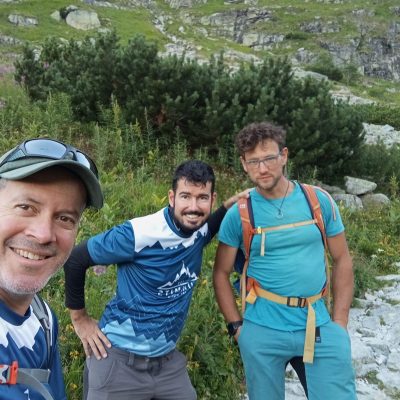
At 5:30, we met punctually at the place indicated by Kuba, who was waiting for us with a delegation of Poles who would also be summiting with other guides and rope teams (in future articles, we’ll talk about the relationship and connection between Poles and the mountains, which is very intense, given that many of the greatest mountaineers in history are originally from Poland). We filled the 9-seater van for a 30-minute road trip to Sliezky Dom, a lodging place that, at 1,670 meters above sea level, is the starting point of the route.
Before we set off, my attention was drawn to our guide’s feet. To be more specific, I noticed his missing toes. He told me that he lost them in the Karakoram (a mountain range in the Himalayas that borders Pakistan, India, and China), famous for hosting the 2nd. On this climb, along with his expedition companions, he had to remain trapped at 7,000 meters above sea level for several days, and in his case, he suffered several bouts of frostbite, which unfortunately proved so severe that nothing could be done to save his toes. A major handicap for someone who makes a living in the mountains, although it seems that, judging by his daily work routine, he has more than overcome this adversity.
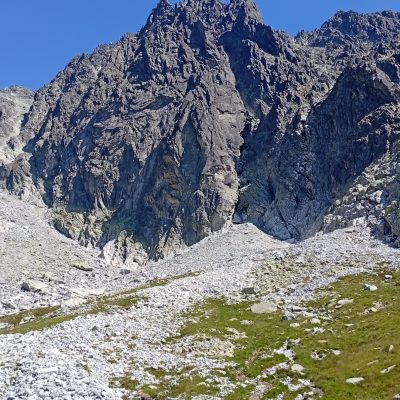
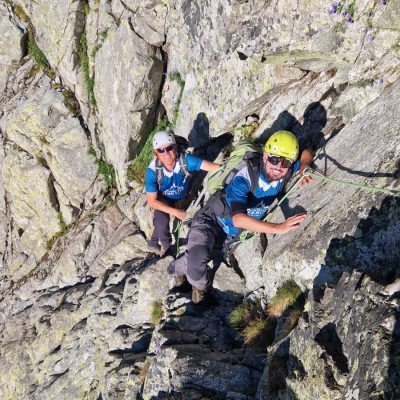
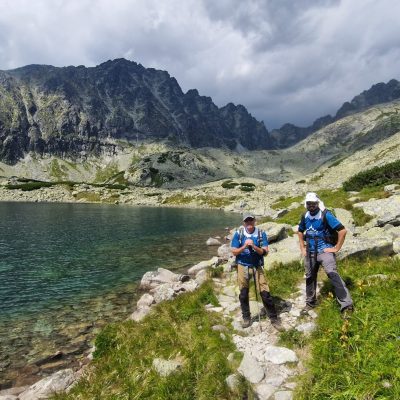
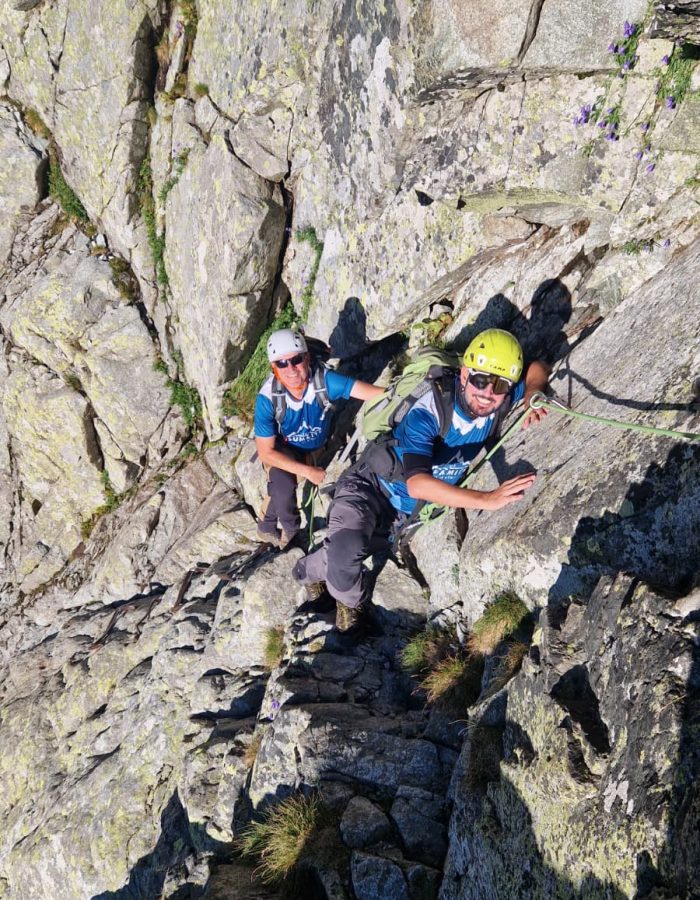
The classic route begins steeply, and in just over an hour, we complete a 500-meter elevation gain that takes us to a height of 2,200 meters, at the start of the wall we must climb roped together. I have less experience than Xec with ropes (he recently climbed the Matterhorn), so my position in the rope team will be in the middle, behind Kuba and in front of Jordi.
Kuba demonstrates absolute knowledge of the terrain. In fact, he also climbed Gerla the day before, so he’s very familiar with it. This knowledge of Kuba has a positive impact on us, giving us absolute confidence that makes our progress to the summit a joy. It seems that, finally, the bad experiences with guides are a thing of the past, and I’m back to enjoying the mountains.
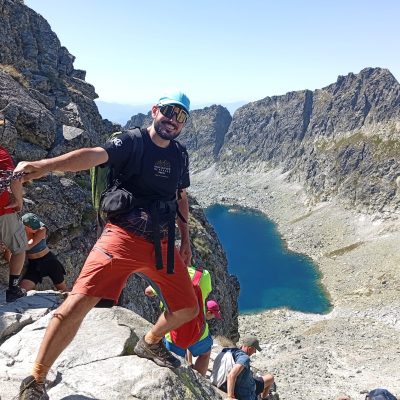
Although the activity we carried out presents risks and dangers, Kuba’s excellent professional practice minimizes them (he shows us the exact route where we should place our hands and feet at critical points), and we really have a great time on the route. A very dynamic route that gains and loses altitude, in which we climb and descend…
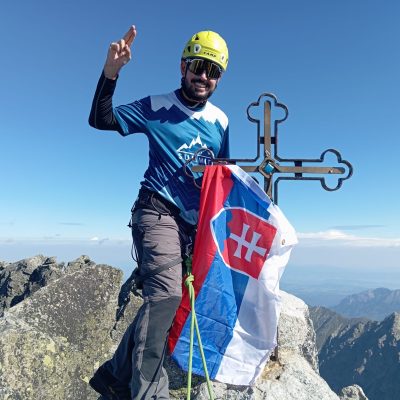
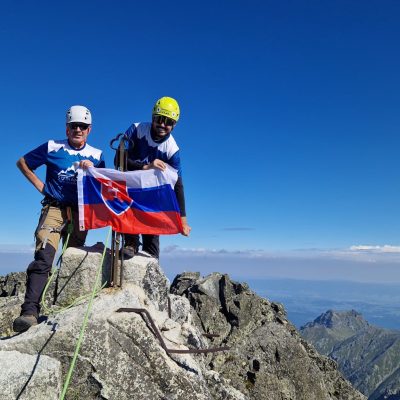
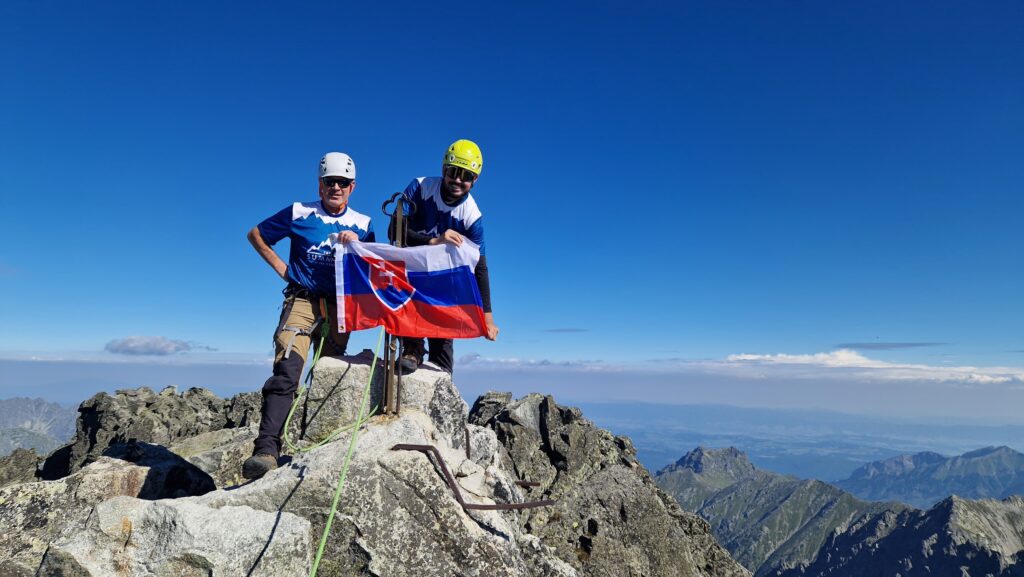
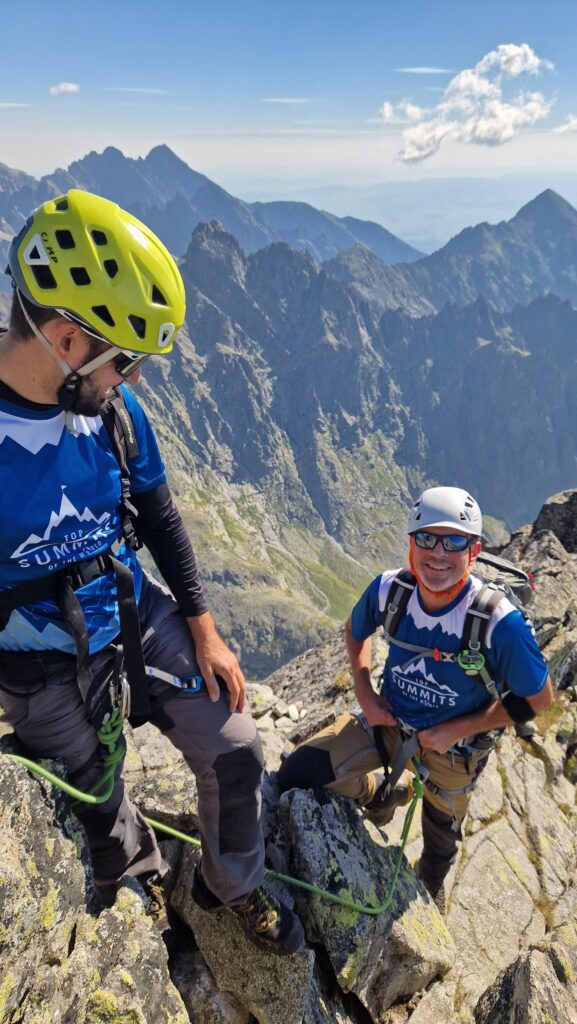
The 2,655 meters arrive sooner than expected. We’ve fallen into a good rhythm, and the rope team has flowed wonderfully well up to the Slovak summit. With “xec,” we’ve been gaining experience as a “rope team,” and today the hours we shared together last year in the Alps (ascents of Mont Blanc and Monte Rosa) have been very useful. The memories we shared together as a rope team help us communicate much better (verbally and without words) and know what each person needs at each moment.
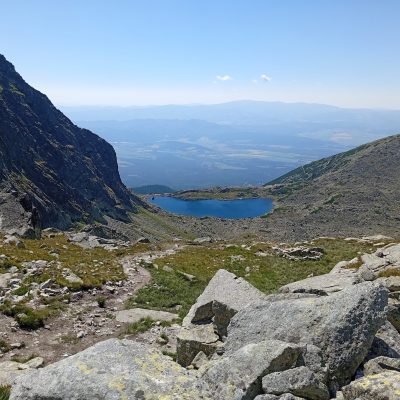
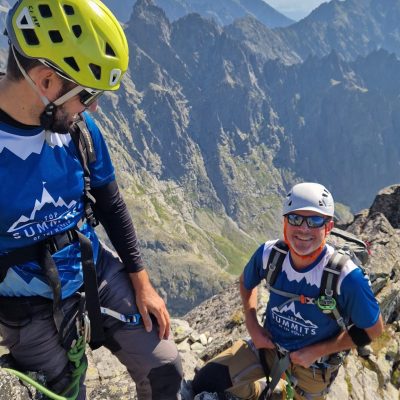
From the top, we enjoy privileged views of the Tatra Mountains while also seeing our next and imminent objective: the Polish Rysy. The intensely green landscape is unique and a feast for the eyes, so we take our time enjoying this visual spectacle.
The low, exposed terrain rounds off a fantastic day of mountaineering, in which we had a lot of fun while also requiring us to maintain high concentration during the hours we were roped up.
The “Polish” van is waiting for us, and on the return journey, we share the joy of successfully climbing the Slovakian peak and explain our world summit project. This project, which presents as its immediate and imminent stop the highest peak in their country: Rysy at 2,499 meters. But that will be for another day; the Slovak adventure concludes here with a resounding and absolute success: “Top Summit” number 26 in our backpack.
GALLERY